Still here: Seniors face silent epidemic of isolation in care facilities

By Grace O’Rourke
Palos Verdes High School

Loneliness is killing people.

Not slowly, not quietly.

It carries the same heath risks as smoking 15 cigarettes a day.

This epidemic is not affecting the younger generations sitting in their rooms on their phones, but targeting the generation that has been on this Earth much longer, the generation that has lived, laughed and loved. But now they spend their days trapped in facilities. For them the most exciting thing they get to hear is the background noise of a TV, the most exciting thing to see is the outside of a window. They yearn for somebody, anybody to care, to show up, and to just sit with them for even 15 minutes.

“Some days the loudest thing in my room is the TV, and I’m not even watching it, I just like to leave it on so it feels like someone’s there,” said Dorothy, 82, a resident at a senior care facility. “When someone sits down and actually looks at me, not through me, that’s my everything.”

Senior isolation has become one of the fastest growing public health crises in America. Studies link chronic loneliness to the same health risks as smoking 15 cigarettes a day, yet for many elderly residents, days pass without a single meaningful conversation. As families continue to grow busier and senior living facilities fill up, an entire generation risks being forgotten.

The reality is that these people are at risk of serious health issues, both physically and mentally. “People think loneliness is just sadness. It’s not,” said Marcus, 34, a caregiver. “I watch it affect them physically. They stop eating. They stop wanting to get up. It compounds everything. I have 12 residents on my floor, I wish I could sit with each of them for an hour. But that’s just not possible for me to accomplish alone, there’s not enough hours in the day.”

For Dorothy the isolation deepens after family visits become less frequent. “I have four grandchildren.” She said, “I see them at Christmas if I’m lucky. They’re busy. I understand that. But understanding it doesn’t make the quiet go away.”

Dorothy is not alone. Researchers estimate that more than one-third of adults over 45 report feeling lonely, and nearly one-fourth of adults over 65 are considered socially isolated, numbers that only have grown since the COVID-19 pandemic forced care facilities to restrict visitation for months at a time.

Some volunteers are stepping in where staffing falls short. Linda, 58, began visiting residents once a week after retiring and quickly found the relationship went both ways. “I started coming once a week and now I can’t imagine not coming,” she said. “Dorothy saved me as much as I saved her, honestly.”

For Marcus, the solution starts with simply showing up. “Being able to talk to someone outside of these four walls, even for 10 minutes, changes a person’s whole day,” he said. “We just have to decide they’re worth that 10 minutes.”


Impact of AI in Education on Children’s Cognitive Development.

Photo by Ksenia Chernaya on Pexels.com

By Addison Pendegraft
Johns Creek High School

From Duolingo to ChatGPT, AI has been festering itself in the educational field more and more everyday. AI promises a mix of both opportunities and dangers, but whether or not society will be able to properly regulate its use will determine the aptitude of generations to come.

“AI use longterm will be harmful to both student and teacher advancement,” said Kirt Jolly, an elementary school teacher for over 10 years. “The student will continue to lose important critical thinking skills due to its use.”

AI, specifically generative AI (GenAI), has become a prominent issue in schools. AI was first entered schools immediately after the public release of ChatGPT in 2022. By 2023, it was widespread among students to complete their homework, formal implementation and structured guidelines followed shortly after, with institutions officially incorporating GenAI into the curriculum.

“Over reliance on AI tools and platforms can put children and youth’s fundamental learning capacity at risk,” said a yearlong, global study conducted by the Brookings Institution’s Center for Universal Education. The article went on to say that, “with limited safeguards and a risk of inaccurate information, can lead to diminished learning experiences.”

Brookings’ study went on to report a major concern on AI: it doesn’t just harm students’ cognitive development, but actively places them at risk of mental decline. This decline occurs from one of the main risks with AI, as students’ repeated use comes with the threat of developing a strong dependence, creating a vicious cycle to their maturation. As students use AI to “offload” their cognitive tasks, and a “positive feedback loop emerges where they see positive results in terms of grades and in time and effort saved.”

This increased dependency and lack of mental stimulation eventually results in “cognitive atrophy,” which has longterm consequences such as diminished critical inquiry, increased vulnerability to manipulation, decreased creativity and greater risk of internalizing shallow or biased perspectives.

This idea is supported by the National Library of Medicine, which reported that “reducing critical thinking as adolescents rely on AI tools instead of their own thoughts and ideas, which may inhibit young people’s cognitive development.”

But AI does hold some benefits in the education system, according to Brookings’ study, proper use can provide teachers with extra time in their busy days by taking care of menial tasks, “enabling more high-value interactions with students.”

According to the National Public Radio (NPR), AI can utilized to assist students with their reading development, especially for students that are learning a second language. “AI can adjust the complexity of a passage depending on the reader’s skill, and it offers privacy for students who struggle in large-group settings.”

However, AI has proven to be a very dangerous tool, especially to our youth, so society must be cautious about its utilizations if its to properly take advantage of its aid. “If regulated properly, it can be a great teaching tool…” Jolly agrees. “The unfortunate issue is things like this are never regulated with the precautions needed for it to be an effective tool.”

Has Sports Betting Changed Sports Fandom For The Worse?

By Becket McDuffie
Palos Verdes High School

The loudest reaction in my living room wasn’t when Georgia scored the game-winning touchdown. It was when a meaningless 3-yard rush ruined someone’s parlay.

“Are you kidding me?” my friend yelled at the TV.

At first I thought he was upset about the game. He wasn’t, Georgia was winning. The season wasn’t on the line. Nothing had changed except the fact that one player had failed to reach a statistical milestone he needed for a bet.

Photo by Tobias Pedersen on Pexels.com

That was the moment I realized some fans aren’t really watching sports anymore. They’re watching their gambling slips.

Growing up, sports were simple. My friends and I argued about who would win, who deserved a championship and which players were the best. Now those conversations sound different.

“Did you hit your parlay?”

“What’s the over-under?”

“Did that touchdown cash your bet?”

Somewhere along the way, the game stopped being enough. Sports betting has exploded across America, becoming one of the fastest growing parts of the sports industry. While gambling has made games more exciting for some viewers, I believe it has changed sports fandom for the worse by shifting attention away from the teams and competition, towards the money. Ever since the Supreme Court legalized sports betting nationwide in 2018, sports gambling advertisements appear during nearly every major sporting event, and betting odds are discussed as frequently as scores and statistics.

There’s nothing wrong with enjoying sports betting responsibly. For many fans, it adds excitement to games they otherwise might not watch. However, when the financial outcome becomes more important than the actual competition, sports begin to lose what made them so special in the first place.

Photo by Pixabay on Pexels.com

The influence of sports betting is hard to ignore. According to Front Office Sports, Americans legally wagered more than $147 billion on sports in 2024, a dramatic increase from just a few years ago. As betting has grown, so has its presence in sports broadcasts. When fans are constantly being encouraged to place bets, it’s no surprise that many begin to focus more on their wagers than the teams they are supposedly supporting.

Sports betting isn’t going anywhere, and I’m not arguing that it should. Adults should have the freedom to place bets if they choose. But as sports gambling becomes more common, fans need to remember why they started watching in the first place. Sports are supposed to be about competition, loyalty and unforgettable moments, not just winning money. If we reach the point where a missed parlay matters more than a championship, then sports betting won’t have improved sports fandom. It will have changed it for the worse.

Joe Dennis

By Becket McDuffie
Palos Verdes High School

For years, Joe Dennis was always on call. The news didn’t care if he was spending time with family. And it certainly didn’t care that he was shopping for baby strollers with his wife. “We were shopping for baby strollers when I got a call from my contact at GBI, he said, ‘Hey Joe, I need you to come down to Logansville at 5 o’clock tonight,” Dennis said. Like countless times before, Dennis had a choice to make. He could continue the afternoon with his family, or he could chase the story. Joe explained the situation, saying, “I’m having some family time right now, but this is my job, and I need to do this.” For much of his career, journalism dictated Dennis’ schedule. But experiences like that eventually changed how he viewed the profession and led him toward a new role, teaching the next generation of journalists.

While Dennis eventually left the fast-paced world of daily news reporting, he never left journalism behind. Instead, he found a new way to pursue it through teaching. Today, Dennis helps students understand not only how to report stories, but also how to navigate an increasingly complicated media landscape. “I wanted to continue journalism for something that was on a more regular schedule,” Dennis said. “That’s what led me into teaching.”

While Dennis found a more predictable schedule in teaching, his experiences as a journalist continued to shape the lessons he shared with students. Years spent covering the news also changed the way he viewed information itself. “You are overwhelmed with information. I actually struggled with this,” Dennis said.

Having experienced the effects of information overload himself, Dennis believes quality journalism is more important than ever. In a world dominated by social media, he argues that journalism provides something many online platforms cannot: context.

While social media often delivers information through short clips and individual opinions, journalism requires reporters to gather information from many sources and present a fuller picture of events. “Journalism is rooted in principles that other forms of media aren’t,” said Dennis.

Dennis’ view of journalism has evolved in other ways as well. Early in his career, he believed journalists should strive to be completely unbiased. Over time, however, he came to realize that complete objectivity is impossible. Instead, he believes journalists must recognize their own biases and understand how those biases can influence their reporting.

Although Dennis remains passionate about journalism, the most rewarding part of his career isn’t seeing a story published; it’s seeing where his students end up. Former students have gone on to work for organizations ranging from the NBA to the Savannah Bananas. For Dennis, those successes serve as a reminder that his impact extends far beyond the classroom.”Seeing where some of my students go afterwards and how they make an impact is really cool,” Dennis said, “It’s rewarding to know that I helped them get to where they are today.”

Joe G. Dennis: Joe Knows

By Anthony J.T. West
Natchez Early College

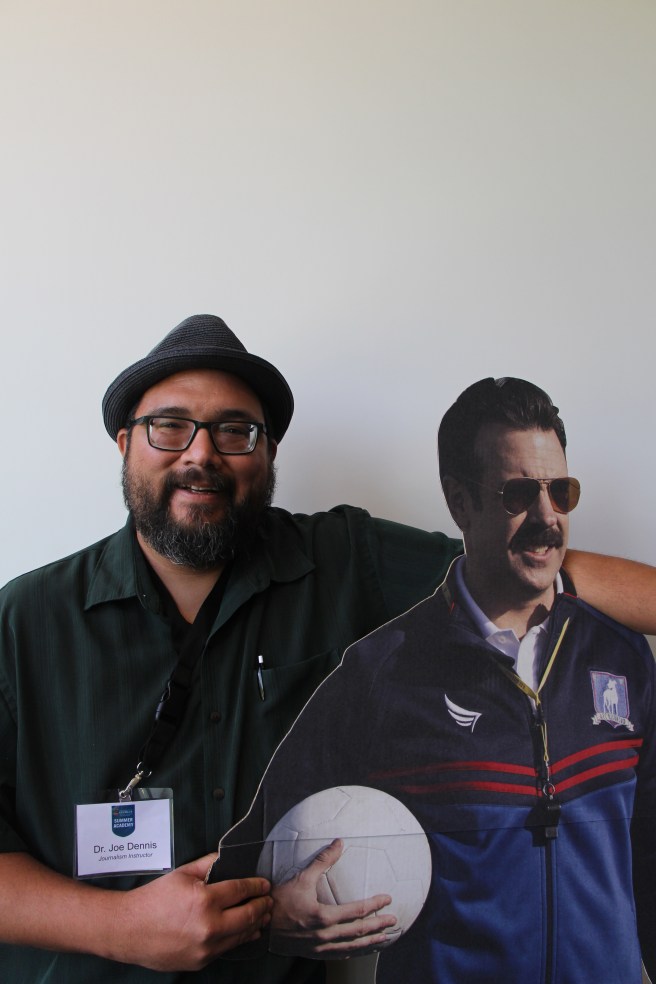
This is a man that wears many hats mainly Fedoras. Behind that hat is a very impactful man who has had an incredible journey in journalism. This a man who has encountered multiple politicians, major sports figures, and civil rights leaders. If you name them he has pretty much met someone that is major in whatever field you want to talk about. This is a man who has a long career that can be summed up into one word “opportunity”. No matter the circumstances or the obstacles he has to face he is a person that remains humble, dedicated, and passionate about his job in the field of journalism. I am talking about the one, the only Dr. Joe G. Dennis. “This is my job I need to do this” Joe said. “I really wanted to do something in the field of journalism”.

Joe Dennis went to a college named North Central College in Naperville, Illinois. It all started when he became fascinated by the uniqueness of people and wanting to know more about their stories. “Every person has a story, and I want to discover it” Joe says. When he discovered Journalism this became a passion that would have given him experiences with people he probably had no idea he would even meet. During the time he was at college his orientation lead was a sports editor of a college newspaper, and he needed a volleyball reporter. Little did they know that this would set him up for a woman (who played volleyball) he would be with for the rest of his life.

“The stories I heard, wrote and even lived through shaped who I am today and the hats I wear. I became an organ donor after profiling a man’s unsuccessful wait for a new liver. My respect for police officers grew immensely after spending 20 hours with a unit during a meth-lab drug bust. My compassion for the poor — especially children — was reinforced after visiting the blighted home of a slum-lord victim.” Joe said. This shows to me that not only does he do journalism to ask questions to people. He also does it because genuinely cares about people and their well being and I feel that is one of the most important things you need to have to be successful in this industry.

“My career has given me the opportunity to hang out with several “stars,” such as musician John Mayer, WWE superstar Chris Jericho and basketball legend Isiah Thomas. I’ve met several historical figures including civil rights leaders, war heroes and prominent politicians.” Joe says. Not only does he interview regular people on a day-to-day, but he also has talked to, interviewed, questioned, and met some of the most famous people in the world. How many people can say that they have met some of the most famous people in history while having a one on one with them asking questions? This man has lived a life that people can only dream of. It maybe even became a surprise to himself that he would have been able to get the opportunities that would have changed his life forever.

Joe G. Dennis has had an extraordinary career built on curiosity, hard work, and a passion for telling people’s stories. His journey shows us how journalism can open doors to incredible opportunities while also teaching valuable lessons about compassion, empathy, and understanding. Whether interviewing ordinary citizens or world-famous figures, Joe has always remained committed to learning about others and sharing their stories. His career is an amazing example of how dedication and a genuine interest in people can lead to a meaningful and impactful life. “Just being nice.” He says, “Communicating with everyone nicely. Just try to be a nice person and a good human being. By taking an active interest in other people and it will pay-off.”

Morgan Hardy

By Grace O’Rourke
Palos Verdes High School

A young girl sitting in front of a camera for her middle school’s morning show broadcast had no idea she would be setting the course for her future and the time to come. Years later, that girl would go on to co-produce a Student Emmy Award-winning documentary about one of the most devastating school shootings in Georgia history, where she would overcome the difficulties of sitting face to face with grieving families, asking the questions that nobody wanted to answer, so that she could tell the story that needed to be told.

“The first thing that drew me to journalism was communications,” said Morgan Hardy, a second-year graduate student at the University of Georgia’s Grady college of Journalism and Mass Communications, “and for me, communication is learning about other people.”

Hardy who earned her bachelor’s degree in journalism and mass communication from Grady, along with a minor is sociology and a certificate in news literacy, has spent years turning that curiosity about people into a career. From broadcasting daily news announcements in high school to launching her school’s newspaper, Hardy has never stopped chasing stories.

At Grady, those instincts were put to the test in the deepest way possible. Hardy served as a producer and social media producer for “We Will Rise: The Story of the Apalachee High School Shooting,” a documentary that earned a Student Production Emmy Award. The project required her to interview grieving families and community members who witnessed the tragedy firsthand, something she describes as one of the hardest things she has worked on.

“Interviewing those families and people in that town was really tough,” Hardy said. “What they saw firsthand was really hard to swallow.”

As someone who feels deeply, Hardy had to find a way to keep going. “I’m an empath so when people are really upset I kind of feel that too, just hearing the graphic details, that was really tough: to set my emotions aside and ask the questions, knowing its gonna hurt.”

She learned quickly that there was only one way through it.

“I really learned you can’t go in head first,” Hardy said. ” My toughest thing was going in small and taking baby steps, making them feel comfortable to even talk about something like that.”

That same patience and willingness to adapt has defined how Hardy approaches journalism as a whole. When asked about figuring out what kind of journalist she wants to be, her answer was simple. “You won’t know until you try,” she said.

That openness to trying led her to UGA, a decision she says changes everything. “If I didn’t go to UGA, I don’t think I would’ve had as many opportunities,” Hardy said. “It’s so incredible that a school has so many connections.”

For someone who simply started wanting to connect with others, the journey has exceeded every expectation.

“So far so good,” Hardy said. “It’s opened so many doors I never knew could be opened.”

Joe G. Dennis: just be a nice guy

By Sam Crumly
Stonehaven Upper School

Just Your average Joe

John Mayers the seven time grammy award winning singer and guitarist, Chris Jericho a prominent WWE wrestler and lead singer of the heavy rock band Fozzy, and Isaiah Thomas an NBA hall of Famer. what connects all these people? Just your average Joe, Doctor Joe G. Dennis. How did he make all of these connections? “Just being nice.” He says, “Communicating with everyone nicely. Just try to be a nice person and a good human being. By taking an active interest in other people and it will pay-off.”

Joe G. Dennis began his career in Journalism, and mass communication at North Central College university, he worked at the Walton tribune, as well as Reporter Progress News and now is working as the associate professor of mass communications at Piedmont University. Doctor Dennis always had an interest in actively telling the stories of the people all around him. This zealous curiosity is what led him to be so interested in this career as a whole. He always had this passion, but his intentions began to evolve to a desire to work as a teacher. He states that his intentions for his career changed when quote, “I was out with my wife, who was pregnant at the time, shopping for items for our baby, when I got a call. From my contact at the GBI (Georgia Bureau of investigation). Saying that I needed to drive down to Loganville to meet up with them for a drug bust they were about to conduct on a kingpin in that area. Telling me ‘this is gonna be a great story you won’t want to miss it.’ And I realized, aw man, this sucks, I’m having some family time and now a have to drive down to Loganville. The reality of the profession I was in is that this would be happening a lot when the baby came.” This type of situation was not the type of situation that could be ignored. Leading him to turn to teaching instead.

Dennis’s entire career as a Journalist was about telling the story of other people and showing the world what their lives were like. He reported on a couple keeping their chapter of the Red Cross alive in their own home, the infamous drug bust with the GBI, and also the story of a judge who was unable to get access to an organ transplant in time. The main thing even allowing him to do all of this was his network of connections. Which he maintained by, “Keeping up contact with each of the people you meet in your life. Not treating them like contacts, but instead treating them like human beings. Building a rapport and trust with each of the people you know. Because you never know who could become your next contact.” This concept is what allowed Joe Dennis into these all of the rooms where he could be the one trusted to tell these stories.

Staying grounded in reality as well, telling stories about people in his own community. Also stating that, “We consume lots of information, try and limit your information from the internet and focus on the reality of it all.” Because although lots can be learned from the internet, lots more can be learned from the real world. The stories that happen in the embodied world and don’t make to your for you page on reels.

Although his career as a journalist was an incredible one, it was a demanding one. Having to sacrifice personal time for the sake of those stories, as we saw with him having to leave his wife for a story. He states that, “I really wanted to something in the field of Journalism, but with more of a stable schedule, leading me to teaching at Piedmont.” This conflict is what made him change his career so that he could focus more on his own story with his wife and family. while still leaving his skills in the field of reporting to his students at his job at Piedmont.

Behind the Wheel: Beyond the Stereotype

By Bristol Hardman
Madison County High School

For many people, Nascar is just a group of drivers making endless left turns around a track. But spending a few minutes inside a race car — traveling nearly 200 miles per hour, enduring extreme heat, split-second decision-making and hours of physical strain — and that opinion quickly changes. The belief that Nascar isn’t a real sport ignores the athleticism, mental toughness, and skill required to compete at the highest level. If sports are defined by physical ability, strategy, training and competition, then Nascar deserves a place alongside football, basketball and every other major sport.

Brad Keselowski is a 42-year-old Nascar Cup Series Champion. All throughout his Cup Series career, he has had major injuries like a broken femur and fractured ankle and he has had to recover through physical therapy. But he still got in the race car and raced.

On March 2, 2025, Brad Keselowski’s cooling-suit failed and he was sent to the infield care center to be hooked up to an IV to get the fluids he needed. The race car he was in got up to 150°F and his body heat was 130°F, so in total the race car felt like 280°F. Athletes in other sports do not have to experience what 280°F feels like, but these racers feel that heat every time they step into a car to race.

Photo by Sean P. Twomey on Pexels.com

Christopher Bell is a 31-year-old All-Star Race winner. Bell is one of the younger drivers and he is a little smaller than the other drivers. On June 7, 2026, he was racing for the lead at Michigan and he collied with Chase Elliot and hit the wall at 200mph and demolished his car and Elliot’s race car as well. His injuries were a fractured wrist. He did not speak with broadcasters after to get his side of his story.

Nascar drivers have to go through extreme practices to get their bodies to even be able to stand the heat and exhaustion that goes into racing. They go through cardiovascular conditioning, extreme heat training, hydration protocols, and extensive mental and stimulator practice. During their cardiovascular conditioning they tend to cycle, run and swim to learn how to keep their heart rate down under stress. While doing heat training, they sit in warm environments like hot yoga to get their bodies used to the high temperatures in the race cars. They also work on their strength and flexibility, which focuses on neck strengthening and upper-body stamina to withstand the weight of the helmet and the steering force.

People tend to say that these drivers aren’t athletes because they think the machines do all the work and that the drivers don’t do the standard athletic movements. Nascar doesn’t change anything major in the race cars unless there is a major injury or death so until something physically happens, the rules stay the same. That is not right. They should be changing the race car every time a driver enters it because the safety of these drivers should be the first priority.

Yes, fans do not like the changes that the teams do because it could make the race car slower, or that it is not the same as the 1980 stock cars that everyone fell in love with. But in this day and time, you can’t have those cars because of the competitiveness and how light these cars are, and that can result in more injuries and flips.

If the fans of Nascar would actually think about these driver’s safety instead of just thinking about their experience and how fast the car can go, there wouldn’t be as many injuries, deaths or malfunctions happening to these drivers. Athletes get in these race cars because this is what they love to do, even if there is a chance that it is their last, because anything can happen in a split second.

Finding Her Voice Through Journalism : Featuring Morgan Hardy

By Jeremiah McKinney
North Cobb High School

From launching a high school newspaper to helping produce an Emmy Award-winning documentary, Morgan Hardy has dedicated her journalism career to telling meaningful stories that make a difference. What began as an interest in morning show broadcasts during middle school grew into a passion that continued through high school and into college. Through internships, researching and in depth reporting, Morgan has worked to demonstrate that journalism has an impact on society. Now pursuing a masters degree in journalism and mass communications at the University of Georgia, she continues to build a career centered on uncovering stories that matter and sharing them with audiences through innovative digital media.

“It’s always been something I’ve always wanted to do,” said Hardy.

Long before producing digital content and gaining recognition for her work, Morgan was the kid that never wanted to miss the news. Breaking news especially caught her attention. “Every time breaking news was on I was like, oh my gosh turn everything off, we’re watching breaking news.”

She often found herself watching broadcasts with curiosity. While others focused on the events unfolding on the screen, Morgan became interested in the people behind the stories. She wanted to know who wrote the scripts, gathered all the information and delivered the news to audiences. “I would sit in my dad’s office and watch MSNBC and I’m like I want to be up there, I want to write their script.”

That early fascination with journalism eventually led her towards a career dedicated to story telling and informing communities.

Morgan’s interest in journalism soon became more than just watching the news. In middle school, she joined her school’s morning show broadcast, giving her a firsthand look at what it was like to help create content for an audience. That experience continued into high school where she spent four years on the journalism staff. During her first two years, she worked in broadcast journalism for the daily news announcements before expanding into other forms of storytelling.

As her skills and confidence grew, Morgan took on a larger role within her school’s journalism program. She helped launched the school’s newspaper and began producing digital content for its website, including video and audio stories. Through these opportunities, she discovered a passion for multimedia storytelling and connecting with audiences through different forms of media.

Morgan’s passion for storytelling continued at the University of Georgia Grady College of Journalism and Mass Communication. Throughout her undergraduate career, she gained valuable professional experience through internships and digital media projects. Working with organizations such as the Oglethorpe Echo and The Christian Index, she created content and analyzed audiences’ engagement and developed strategies to connect with readers across digital platforms. “If I have not gone to UGA, I don’t think I would be able to do something of this magnitude,” said Hardy. These experiences helped her strengthen the skills she had developed in the classroom while preparing her for a career in journalism.

One of the most meaningful experiences of Morgan’s career came during her work on the documentary “We Will Rise: The story of the Apalachee High School Shooting.” As a social media producer, she conducted research, interviewed sources and helped create content that shared the story of a community facing tragedy. “It was really tough to set my emotions aside knowing it’s going to hurt.”

Working alongside her team, Morgan helped tell a story that not only informed audiences, but also honored those affected by the event. The documentary later earned a student production Emmy award, marking a major milestone in her journalism journey.

Now entering her second year as a graduate student at the University of Georgia, Morgan continues to build on the passion that first began while watching breaking news as a child. Through internships, digital storytelling and award- winning projects, she has remained committed to informing communities and telling stories that matter. As she continues her journey in journalism, Morgan hopes to use her skills to make a lasting impact through meaningful and engaging storytelling. “You won’t know until you try.”

Morgan Hardy: A Rising Voice on the Stage of Journalism

By Kirsten Jolly
New Manchester High School

How do you differentiate between artificiality and authentic work, and furthermore how can a line be clearly drawn between the two, if it is impossible to tell where deception began? As a journalist, UGA Graduate Student, Morgan Hardy faces these questions every day, and strives to responds to them with boldness and bravery as she relentlessly pursues truth into the future.

To Hardy, being a journalist is much more than just writing and reporting. It’s understanding, knowing and connecting to the people you are writing about, and representing them in a light that is true to them. “We are real life people,” Hardy declared, while emphasizing the importance of intrapersonal connection as a journalist.

“Put your voice in your writing,”. she stated. Here, she highlights how emotional connection is something that is unique to humans, and can’t be easily replicated by Generative AI, despite implications by some in the journalistic industry.

Hardy’s perspective on this is a breath of fresh air compared to the overwhelming narrative about Generative AI in a contemporary society; as many seem to be disregarding the value of human journalists, and overestimating the capability of artificial intelligence. Hardy continues to discuss struggles she faces while rising in the industry, mainly focusing on the integration of AI into creative fields.

Hardy described how she finds herself to be dissapointed with said integration, as it is being forced upon us, rather than offered as an option. She continues to recognize the danger of that, not only as a journalist, but a youth leader entering the world. Despite the precedent, Hardy drives her own opinion about who (or what) exactly will be leading the next generation of democracy: the talented and inspired youth.

She admires the tenacity and creativity of young journalists, and how they approach tackling difficult topics in unique ways. Hardy specifically recalls her admiration of a certain journalist who captivated her audience by being funny and relatable, before highlighting the deeper issue about the topic she was covering. Hardy explains how she senses a real shift in the industry towards something greater than AI: authentic youth innovation.

As the stakes continue to rise, Morgan Hardy stays set on tackling the tough topics, and approaching them in a sensible, emotional and uniquely human way. Her influence and perspective is something that creates a space where many can feel accommodated for, and understood. As her journey continues to evolve, her voice does as well, stating the things left unsaid, and representing those left unheard.