
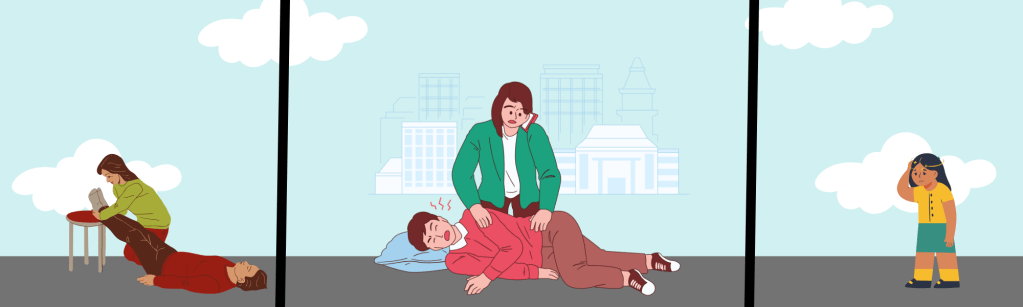
Imagine someone in your class or work place suddenly collapsing to the ground. What do you do? Do you call for help? Do you give them water? Do you just stare and hope they wake up?
“I want people to talk to me and remind me that I’m safe,” said Alondra Pagan-Galarza, a high school student who has functional neurological disorder, which causes her to have functional stress seizures. “Distract me from the situation, talk about something random. Others like to be left alone but I like the social aspect, I like physical contact. I like to know that people are there.”
According to UNC Health Talk, if a person has a seizure they should lay on their side and have their head supported with a pillow. Blankets, jackets or keeping their head up with one’s hands can work as long as one’s head isn’t being hit. Don’t restrain them if one is holding them. Those who faint should be laid on their back and their legs should be above their heart. It’s a good idea to loosen tight clothing or necklaces so blood can easily move.
People want someone, not a group, with them when they pass out just for some peace of mind. It comforts others to know that someone cares. At the end, let them get up at their own pace and then get some fresh air. Give the person some water and some food to recover after the episode.
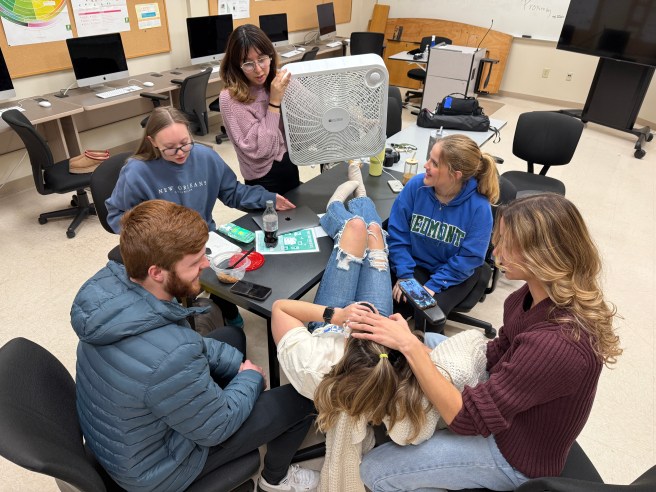
Maggie Bishop, a student at Piedmont University in Georgia, was diagnosed with Tachycardia and PNES (Psychogenic Nonepileptic Seizures) which creates psychological seizures. “Sometimes people don’t know they have this until it [a person passes out] happens. Knowing what to do if someone does have one is beneficial. You never know where you’ll be when it happens.”
Fainting and seizures have their similarities and differences. Fainting usually is for less than 30 seconds, whereas seizures can be three minutes. Seizures could be small with very little movement to large movements. Fainting can have some shaking and their body can move slightly.
“A good analogy of FND that a lot of people use is a computer,” Pagan-Galarza said. “A computer works right, the hardwares works right, everythings good. All the buttons click but the software is what doesn’t work. It’s inside the computer and you can’t see it.”
According to Patient, four out of 10 people will faint once in their lifetime. This occurs when there is a drop of blood pressure and blood can not make it into the brain. It can be caused by heat, standing for long periods of time, stress or fear, having little salt or fluid or even standing up too quickly. There are reflex, cardiac, orthostatic and neurologic syncopes. Reflex syncope is most common with vasovagal, situational and carotid sinus. Teenage girls and older adults are the most likely to faint.
“When I actually have a seizure I shake, zone out for like 20 seconds and then I jump but for some other seizures I might shake and I might be paralyzed because that is one of my other symptoms,” said Pagan-Galarza. “When I wake up my brain is still foggy. It’s still confused and I need a minute to process because it’s [brain] been through lots. It’s not any electrical signals, the seizures are not epileptic and don’t cause brain electricity. It’s due to stress and anxiety.”
The World Health Organization says that 5 million people are diagnosed with epilepsy each year. Seizures can also be caused by brain tumors, brain injuries, infections, fevers or electrolyte imbalance. Menstruation, stress, some medications and lacking sleep can also cause someone to have a seizure. There are different kinds of seizures: absence, tonic-clonic, myoclonic and atonic. There are also functional seizures where it looks like a usual seizure, but is not caused by the extra electrical brain activity like the ones above.
“I’ll get light-headed and my legs will start twitching,” Bishop said. “My friends have noticed that my eyes start twitching. I don’t notice it because normally I’m already out.”
Not everyone, especially if they have passed out before, wants an ambulance to be called. Hospitals can give a diagnoses of why one fainted and give some things to help. Rescue medications can stop a seizure but sometimes they are stress based and going to the hospital can cause more issues. Listen to what the person wants unless they are in danger.
“I pretty much tell everyone to watch my head so we don’t have to call an ambulance when I’m having a seizure,” Bishop said.
According to the CDC, it’s important to call 911 immediately if one isn’t breathing, can’t be woken up after a minute, has had a seizure for longer than five minutes or has a head trauma. If it’s their first time having a seizure or fainting, calling a doctor is advised. Always search for a medical ID band that can give one information on how to help that individual.
“It’s important [to learn] because you don’t know why they’re having a seizure,” Pagan-Galarza said. “It could be epileptic, it could be non-epiliected. It should be widely known especially for FND because it’s not a well-known condition, even though it’s the second most common neurological condition. People need to know if an epileptic seizure happens for five minutes, you call 911. Your brain is getting bad electrical signals. For FND you don’t do that because it’s caused by stress. Stress doesn’t go away in five minutes.”

 Rock Star Writers Blog