
A second voice and a second brain: The Use of AI In a Physician’s Office

As many know, the use of AI has expanded to many places of work including physician offices. In 2024, 66% of physicians reported that they used AI. There are many different ways that AI is used in the office from helping document visits notes.

Dr. Andrea Dabney is an MD Obstetrician and Gynecologist who works at Emory Healthcare. She was recently introduced to using AI in her office. 

“[We started using AI] I believe in our primary care offices and in the OB offices in early 2025,” Dabney said.

As of now, there is one main use of AI in her office. 

“It’s downloaded onto our phone and we press a record button when we go into the room, and it sets up and it starts recording everything that the patient and I say during the visit,” Dabney said. “So it’s truly called medical transcription. So it doesn’t diagnose, but it lists out your problems that are considered medically related.”

Along with the main use of AI in her office, there is a set back for some of them.

“The AI app is also downloaded onto your iPhone, and right now it’s only available on the iPhone so all providers don’t have this particular app because they don’t have an iPhone,” Dabney said. “So that is one hindrance.”

Like many AI platforms, this app is bound to make mistakes. These mistakes could potentially hinder the doctor from taking the time to do other tasks that they have to get done.

“I think the main mistake I’m noticing after having used it for a couple of months now is when I’m interviewing a patient and asking questions, it’s stating the patient said they have these complaints instead of the patient saying they agreed or denied that they had these symptoms,” Dabney said. “So you definitely have to read every one of your encounters because they can be wrong. Another concern is the patient may come in for what’s considered their wellness exam but they have complaints and so a patient doesn’t understand a complaint and a wellness exam aren’t the same thing and so when the patient goes into having all these different complaints the AI reconstructs your note into a complaint note instead of a wellness visit and you have to go back and re-create it and make it a wellness visit.”

With AI being introduced in the doctor’s office, what do the patients think? For many, AI isn’t familiar, so it can bring out many emotions in patients who don’t know much about the app.

“You announced that you’re using AI and it’s considered medical transcription and I’ve had an overwhelming majority that have said ‘oh cool,’ Dabney said. “But I did have one patient upset and thought that she had been recorded against her will. She wanted me to cancel it out and I told her it would be canceled out of her chart and I would go based on memory for the things.” that I  could remember. She said was very, very upset about it.  And these are patients of all age ranges.

According to Mobius MD physicians spend around ten hours weekly on administrative tasks. It is possible that this workload is stressful on many doctors. So, the use of AI platforms could be seen as more efficient.

Dr. Dabney has many thoughts on the use of AI in her office. She will continue to work and accurately document her patients and persevere through the flaws that the app holds.

“Although [AI app] has its problems, you have to recognize it for what it is,” Dabney said. For now, it’s a huge help because the human mind is not a recorder. It really does significantly change the amount of time that we’re having to spend on charting, which is a huge portion of your job making sure you get your paperwork in as accurately as possible.”
Perfection: The Truth Behind the 4.0

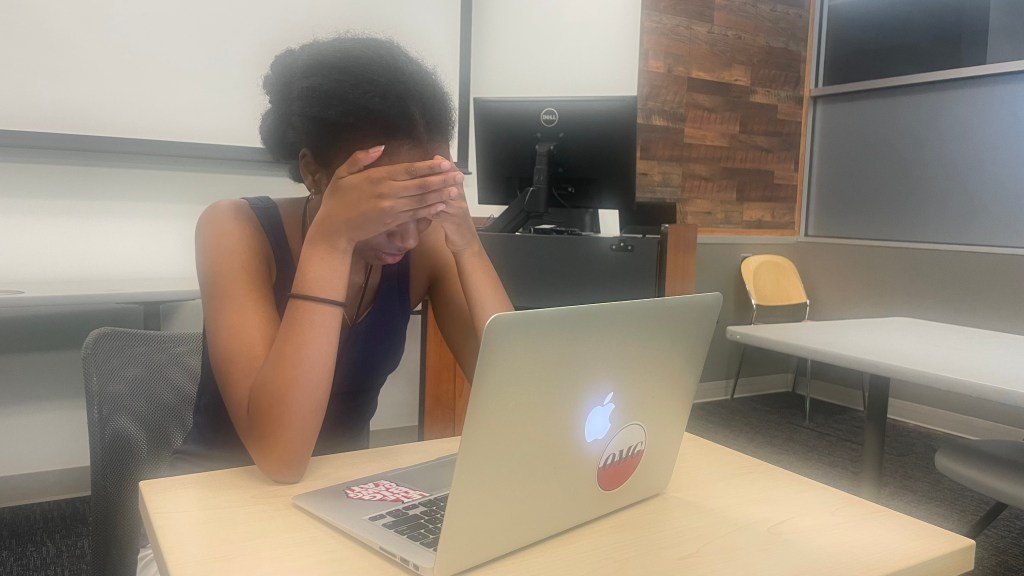
Succeeding and doing well is a goal of many students. But, are they willing to feel the flame of academic burnout?

May 23 was my last day of school. Instead of spending it with end of the year parties or watching movies in class, I was spending it taking my geometry final. After taking my final and leaving the school building with my classmates, I felt stress free. During the school year I had many focuses, but school was most important. Since it was my first year of high school, I wanted to make sure I started it off with a 4.0. All of the late nights studying and working on projects paid off. I earned my 4.0. Although I earned straight A’s, I wasn’t aware of the price that I would have to pay. The excitement of the end of school was temporary. But the feeling of burnout and exhaustion feels permanent and continues to follow into my summer.

At the beginning of the summer, although I slept in a lot, I felt exhausted throughout the day. Sometimes I would even take long naps, which I don’t ever do. Also, getting started with my summer work felt impossible. I would constantly sit around, lacking energy, procrastinating starting my work. I felt so tired, yet so guilty for sitting around. I felt lazy.

Even during the school year I would be greeted with muscle aches. These aches possibly formed because of how tense I was studying for the tests that would trickle in one by one during the week. My sleep schedule was messed up and I would be exhausted the following day. I would hardly give myself breaks because I was so nervous that I was going to fail a test, so I kept studying.

The “Polygence” reported on a 2017 study which concluded that academic burnout shows cognitive, affective and physical symptoms. An example of a cognitive symptom is not engaging in work. An affective symptom is feeling tense and irritable. A physical symptom is decreased energy and chronic tiredness. Another study talked about how experiencing academic burnout causes students to earn lower gpa and perform not as well in school. 

A survey that was recorded by the student president of the William McKinley High School in Hawaii school in 2022, they found that 71% of students reported going facing burnout at least once in their life and 57.3% reported that they experienced it more than once and it’s described as “the main stressor.”

There are many different causes of academic burnout. For many, it’s the immense pressure of perfection. For me, since I usually perform well in school, I didn’t want to slip up and potentially mess up my gpa.

In 2023, Junior Monica Velasquez was given the title gifted at a young age and that brought on the perfectionist mindset.

“Being labeled as “gifted” at a young age planted the thought that everything I do should be perfect,” said Velaquez. “I thought of myself as a failure if I did not perform better than everyone else. My worth solely depended on my grades and achievements.”

As students and as humans we tend to put a lot of pressure on ourselves until we are over the edge. It’s possible for opponents to say that recognizing academic burnout is just recognizing weakness. But the struggles of students deserve to be heard. We shouldn’t just be on the sidelines watching students’ mental wellbeing plummet.

A lot of schools don’t tend to cover academic burnout and its importance in how it impacts students during the school year. I feel like schools should cover how to recognize and prevent it. I also feel like it would be beneficial for parents to talk to their children about how perfection isn’t everything.

As a society we should strive for excellence, being the best we can be, not perfection.

Just Enough of Joe Dennis

In between all of the silly fedoras, there is journalist Joe Dennis. His experiences within his culture have helped him shape him who he is today.

”When someone sneezes, you throw a party,” Dennis said. “Family gatherings are everything [In Filipino households].”

Dennis grew up in Chicago. During his youth, one of the ways his family expressed their culture was through food. He faced hardships, such as discrimination, as a child. Regardless of those hardships faced during his childhood, he’s proud of his heritage and continues to celebrate his heritage with his family through different traditions today.

While growing up, there were many different communities of different cultures. But the community he grew up in was predominately one race, and his family was Filipino. He has written opinion columns culture from a perspective of being some of the only people of color in his neighborhood.

“But I do think that I have written stuff in the past from a perspective of growing up as someone who was different,” Dennis said. “I mean, it was very segregated like that. And we lived in a white neighborhood.”

Throughout his time in Chicago during his youth, he faced the unimaginable.

“And even growing up in the 80s, I was discriminated against a lot, interestingly,” Dennis said. “People thinking I was Mexican and calling me [slur] It’s really hard. How do you deal with that when someone is yelling a racial thing at you that isn’t even applicable to you? It’s kind of like, what?”

Regardless of the adversities in his childhood, he continued displaying his culture with his family through cooking.

 “During the pandemic, I really got into cooking and trying to resurrect some of the Filipino dishes that I grew up eating. And now I’m pretty darn good at it, cooking Filipino food. I cook a coconut adobo,” Dennis said. “When I was trying to get the recipes from my mom, my mom, of course, nothing was ever written down for her. So I’m like, mom, okay, so how much soy sauce do I put in? She’s like, enough. I’m like, how much is enough? Enough. So I really had to kind of figure it out.”

Today, Joe Dennis continues to share the meaningfulness of being Filipino with his son. Showing how he takes pride in being Filipino and his culture

“And on my son’s [Jaydon] 21st birthday, we got matching tattoos,” Dennis said. “So this is the tattoos that we both got. And that is the Filipino flag has a sun and three stars around it. So we got those matching tattoos. So when my son asked me, he said, we should do this. That was maybe one of the most meaningful things my kids, any of my kids have ever said because it was totally unexpected.”

Although Joe faced adversities during his childhood growing up in Chicago, he has continued to embrace his culture. Throughout his time being a journalist and professor, he has made it known for his students apart of different groups that he is there for them.

“But the day after the election, I had, and I write this in the column, I had students in my office. I had an openly bisexual student. I had an illegal immigrant in my office. I had a feminist, basically a self-identified feminist in my office. And I had someone who was severe like anxiety and mental disabilities in my office and an African-American student. And they were all, they just all were devastated, ” Dennis said. “They just needed someone to talk to. They just needed someone to vent, right? They needed to know they weren’t alone, that I was there and people are there to support them.”

Ana Dabney

Scholar. Musician. Daughter

Hi, I’m Ana and I currently live in Decatur, Georgia. I’ve called Decatur home since I was in first grade. I live with my mom Andrea, dad Paul, older sister Alex, and my dog Teddy. I really enjoy Decatur and living near the Atlanta area. The community is really beautiful and it is very walkable.

 I am 15 years old and going into my sophomore year at Decatur High School. For me, getting adjusted to the high school environment wasn’t too difficult. But I am nervous for sophomore year because everyone says it’s the worst year of high school. On the topic of school, my favorite subjects are math (when I’m understanding what we’re learning) and English.

I really enjoy writing stories and letting my creative juices flow. I also really enjoy the research aspect of writing as well. The research is what really interested me in journalism and seeing the reporting being done on TV. On CNN, I really enjoy watching Erin Burnett and look up to her. I’m not exactly sure why I look up to her specifically, but watching her and other reporters makes me want to do the same. They all look like they enjoy their job and I enjoy doing what they do (especially being in front of a camera). Unlike many aspiring journalists my age, I’m not on my school’s newspaper or yearbook team, but I am trying to get into a class which learns about film and eventually gets to contribute to writing for our school’s newsmagazine, Carpe Diem.

Right now, I am exploring my options on what specific type of journalism interests me through this camp. I also did a few mentoring sessions with my aunt Kathy who is a journalist for The Cincinnati Herald. During these sessions, we talked about what I was interested in and introduced me to some material to help me look at what journalists do. For example, she told me what skills are vital for journalists to develop. These sessions have helped me realize that sharing interests with someone who you’re close to, especially when they’re an expert, is a privilege.


Other than writing and research, I really enjoy music. I play piano and have been since fourth grade. During covid, I was still having piano lessons off and on through Facetime before switching to doing lessons full time. I am also involved in my school’s chorus and this year I auditioned for one of the top chorus classes, which I got into. I really enjoy singing and feel like during my freshman year I got out of my shell more and taking more risks during chorus. My quirky chorus director, Dr. ES is who to thank. I auditioned for All-State chorus, which was my first-ever audition for anything, but I didn’t end up making it. Although I didn’t make it, it was still a great experience for me and I know what I need to work on to hopefully make it next year. I also do mixed martial arts and have been for almost two years. During trainings we do kickboxing, sparring and self defense, to name a few. I am currently a brown belt and working towards my black belt. I’ve learned and grown a lot since I was a white belt. I’ve developed confidence, strength and self defense skills.

Through all of my life experiences, I have learned what I think is the most important thing — to take as many opportunities as you can because there are people wishing they had what you have right now.