
How to help the uncounsious

Imagine someone in your class or work place suddenly collapsing to the ground. What do you do? Do you call for help? Do you give them water? Do you just stare and hope they wake up? 

“I want people to talk to me and remind me that I’m safe,” said Alondra Pagan-Galarza, a high school student who has functional neurological disorder, which causes her to have functional stress seizures. “Distract me from the situation, talk about something random. Others like to be left alone but I like the social aspect, I like physical contact. I like to know that people are there.”

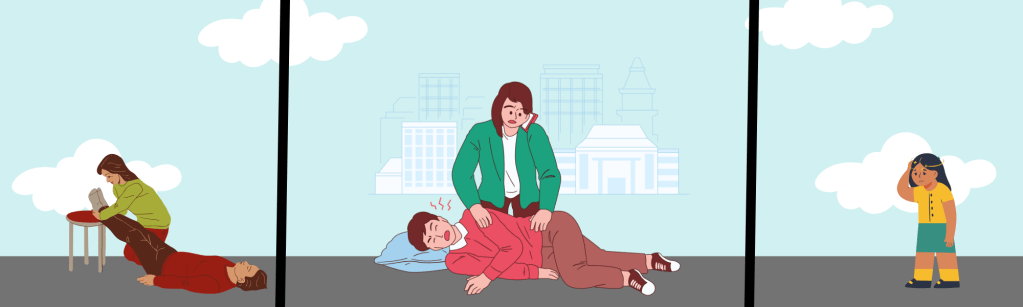
According to UNC Health Talk, if a person has a seizure they should lay on their side and have their head supported with a pillow. Blankets, jackets or keeping their head up with one’s hands can work as long as one’s head isn’t being hit. Don’t restrain them if one is holding them. Those who faint should be laid on their back and their legs should be above their heart. It’s a good idea to loosen tight clothing or necklaces so blood can easily move. 

People want someone, not a group, with them when they pass out just for some peace of mind. It comforts others to know that someone cares. At the end, let them get up at their own pace and then get some fresh air. Give the person some water and some food to recover after the episode.
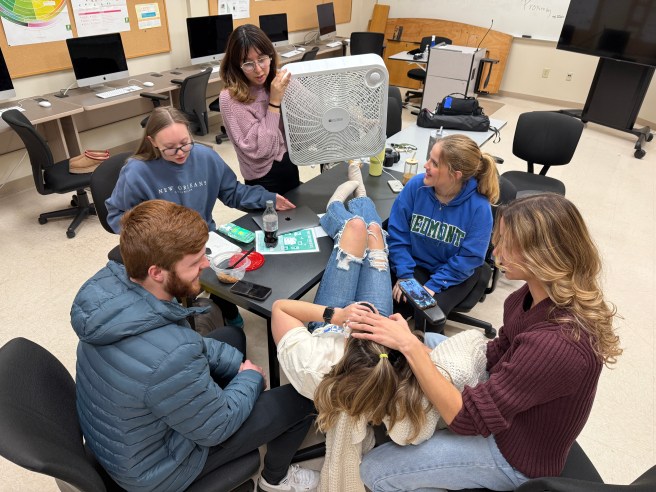
Maggie Bishop, a student at Piedmont University in Georgia, was diagnosed with Tachycardia and PNES (Psychogenic Nonepileptic Seizures) which creates psychological seizures. “Sometimes people don’t know they have this until it [a person passes out] happens. Knowing what to do if someone does have one is beneficial. You never know where you’ll be when it happens.”

Fainting and seizures have their similarities and differences. Fainting usually is for less than 30 seconds, whereas seizures can be three minutes. Seizures could be small with very little movement to large movements. Fainting can have some shaking and their body can move slightly.

“A good analogy of FND that a lot of people use is a computer,” Pagan-Galarza said.  “A computer works right, the hardwares works right, everythings good. All the buttons click but the software is what doesn’t work. It’s inside the computer and you can’t see it.”

According to Patient, four out of 10 people will faint once in their lifetime. This occurs when there is a drop of blood pressure and blood can not make it into the brain. It can be caused by heat, standing for long periods of time, stress or fear, having little salt or fluid or even standing up too quickly. There are reflex, cardiac, orthostatic and neurologic syncopes. Reflex syncope is most common with vasovagal, situational and carotid sinus. Teenage girls and older adults are the most likely to faint. 

“When I actually have a seizure I shake, zone out for like 20 seconds and then I jump but for some other seizures I might shake and I might be paralyzed because that is one of my other symptoms,” said Pagan-Galarza. “When I wake up my brain is still foggy. It’s still confused and I need a minute to process because it’s [brain] been through lots. It’s not any electrical signals, the seizures are not epileptic and don’t cause brain electricity. It’s due to stress and anxiety.” 

The World Health Organization says that 5 million people are diagnosed with epilepsy each year. Seizures can also be caused by brain tumors, brain injuries, infections, fevers or electrolyte imbalance. Menstruation, stress, some medications and lacking sleep can also cause someone to have a seizure. There are different kinds of seizures: absence, tonic-clonic, myoclonic and atonic. There are also functional seizures where it looks like a usual seizure, but is not caused by the extra electrical brain activity like the ones above. 

“I’ll get light-headed and my legs will start twitching,” Bishop said. “My friends have noticed that my eyes start twitching. I don’t notice it because normally I’m already out.”

Not everyone, especially if they have passed out before, wants an ambulance to be called. Hospitals can give a diagnoses of why one fainted and give some things to help. Rescue medications can stop a seizure but sometimes they are stress based and going to the hospital can cause more issues. Listen to what the person wants unless they are in danger.

“I pretty much tell everyone to watch my head so we don’t have to call an ambulance when I’m having a seizure,” Bishop said. 

According to the CDC, it’s important to call 911 immediately if one isn’t breathing, can’t be woken up after a minute, has had a seizure for longer than five minutes or has a head trauma. If it’s their first time having a seizure or fainting, calling a doctor is advised. Always search for a medical ID band that can give one information on how to help that individual.

“It’s important [to learn] because you don’t know why they’re having a seizure,” Pagan-Galarza said.  “It could be epileptic, it could be non-epiliected. It should be widely known especially for FND because it’s not a well-known condition, even though it’s the second most common neurological condition. People need to know if an epileptic seizure happens for five minutes, you call 911. Your brain is getting bad electrical signals. For FND you don’t do that because it’s caused by stress. Stress doesn’t go away in five minutes.”
Why American Sign Language is important

Made by: Maggie L
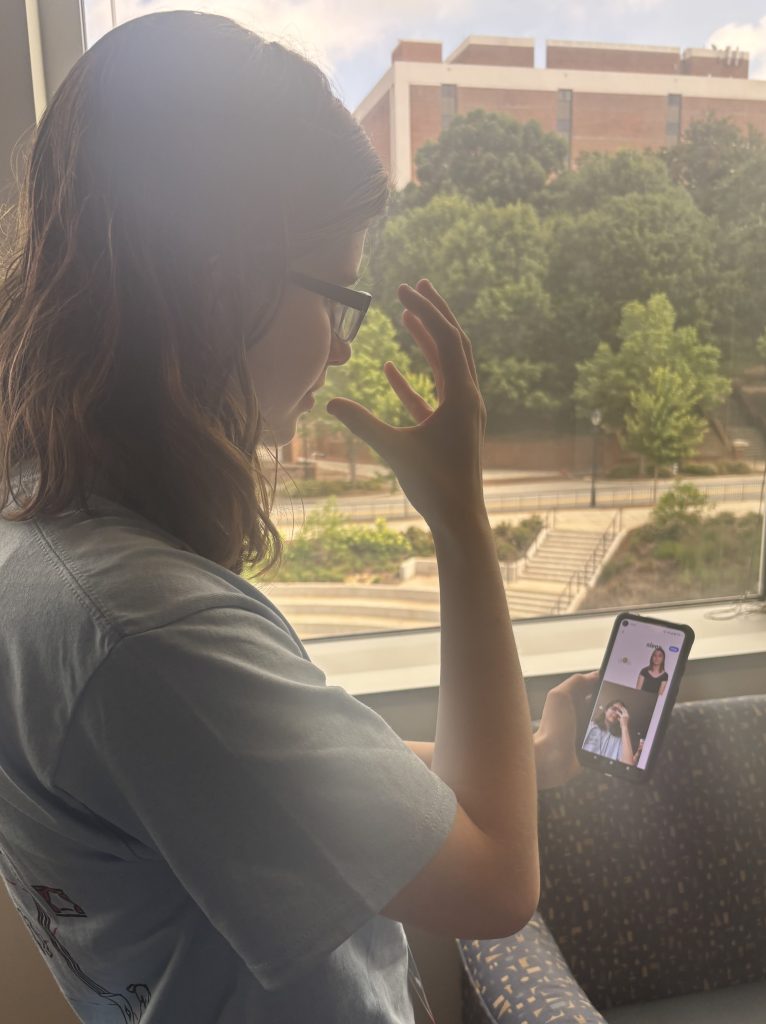
A student learns ASL with an app called PocketSign

Sign language is very important for our world. I have a close deaf friend my age who wears cochlear implants and a deaf adult in my life who mainly signs. This language is also good for when you need to be quiet but still want to talk to others. ASL is a real language with its alphabet, grammar rules and even poetry. 

As the ASL President at Fuquay Varina High School in North Carolina, I know it’s important for people to learn some signs so they can talk to a larger population. Some signs also travel across languages, even though American Sign Language and British Sign Language are different. 

More than 4,000 children are born deaf, according to the Dallas Hearing Foundation. The World Health Organization says that 2.5 billion people will have some degree of hearing loss in 2050. NIDCD says that 15% of adults report they are losing their ability to hear, and one out of three people from the ages 65-74 have hearing loss. 

Some people with neurological disabilities can go selectively mute. Knowing sign for events like these help people feel heard when they are too scared or overstimulated to talk. So with this information, learning sign language is good for the community. 

Sign language is needed for the deaf, mute and families of deaf people. It’s a crucial part of deaf culture that can create beautiful words. Some people don’t believe sign language is a real language because it’s not vocal, nor does it have a writing system. There have been languages before that don’t have a writing system along with the fact that people can understand each other. 

So learn some ASL. Just learning little phrases is a good start. There is a whole new world that you can talk to and the community will love that you want to learn. Search up online or on social media about events near you where you can learn sign language. 

Joe Dennis: Fedoras and Family

Written By Sara Anderton

The fedora-wearing professor, Joe Dennis works at Piedmont University, a private liberal arts college. Dennis teaches his college students and his own kids journalism.

“I have no senior family members that did journalism. I’m the first one to do it, as far as I know,” said Dennis. “My oldest son did a little bit in high school. He won some awards for it too but he’s more into computer programming. My fourteen-year-old has expressed a lot of interest when I’m just talking about things. He has a weird fascination in it. I’m like oh cool, maybe he’ll take after me.”

He has matching tattoos with his oldest son of the sun and stars from the Philipino flag. It connects the two to their culture along with their father-son bond. Dennis also wrote a blog about his three sons and how he raised them along with some fun moments.

Now Dennis writes editorial pieces based on his students lives.

“The day after the election I had students in my office; I had an openly bisexual student, I had an illegal immigrant, I had a self-identified feminist and I had someone with severe anxiety and an African American student,” Dennis said. “They were all devastated and they were waiting for me. I keep my door unlocked and they were all waiting there. They needed someone to talk to, someone to vent to, someone to know they weren’t alone and that really inspired me.”

Dennis has loved being a teacher to his students. They inspire him to write. He gets to be a safe space for them, which is different from his catholic school. The professor enjoys seeing what his students have learned and how they have grown in their writing skills.

And the fedoras?

“Yeah, I have 6 fedoras that I own,” said Dennis.

Most of them are light because of Georgia’s hot weather.

“I do have a favorite, it’s a black fedora,” Dennis said, “I purchased it at the House of Blues in Chicago. It’s kinda the same fedora supposedly that the Blues Brothers wore in the 1980s movie that I loved. So that’s kinda my special fedora. It’s thicker, it’s wool, so I really only wear it in the winter.”

We can see how education matters to Dennis. He continues to teach and wants more people to be interested in journalism. He cares for humanity and enjoys talking to others and learning their stories.

Sara Anderton

Hello There,

My name is Sara Anderton. I’m learning American Sign Language along with Hebrew. Once I finish those two languages I hope to learn Ancient Greek, Aramaic, Arabic, Irish Gaelic and if I have time maybe some Hindi or Spanish because my mom was a Spanish teacher. I am the person who will know the most when someone faints or has a seizure; I’m also most likely to faint with my vasovagal syncope. I love learning cultures and religions. I love to learn in general, so I love journalism where I can learn even more. My family is a big advocate for education for all.

Additionally, I’m Jewish-Christian which basically means I believe in Jesus but I keep kosher and celebrate the holidays. Just think I know Lord’s Prayer and Shema. I study Tanakh (Old Testament) and Brit Chadashah (New Testament). Celebrating both religions is just fun for me and gets me connected to my faith. How I practice isn’t for all but it is for me and I’m proud of my faith. I also go to church in my school so that’s fun.

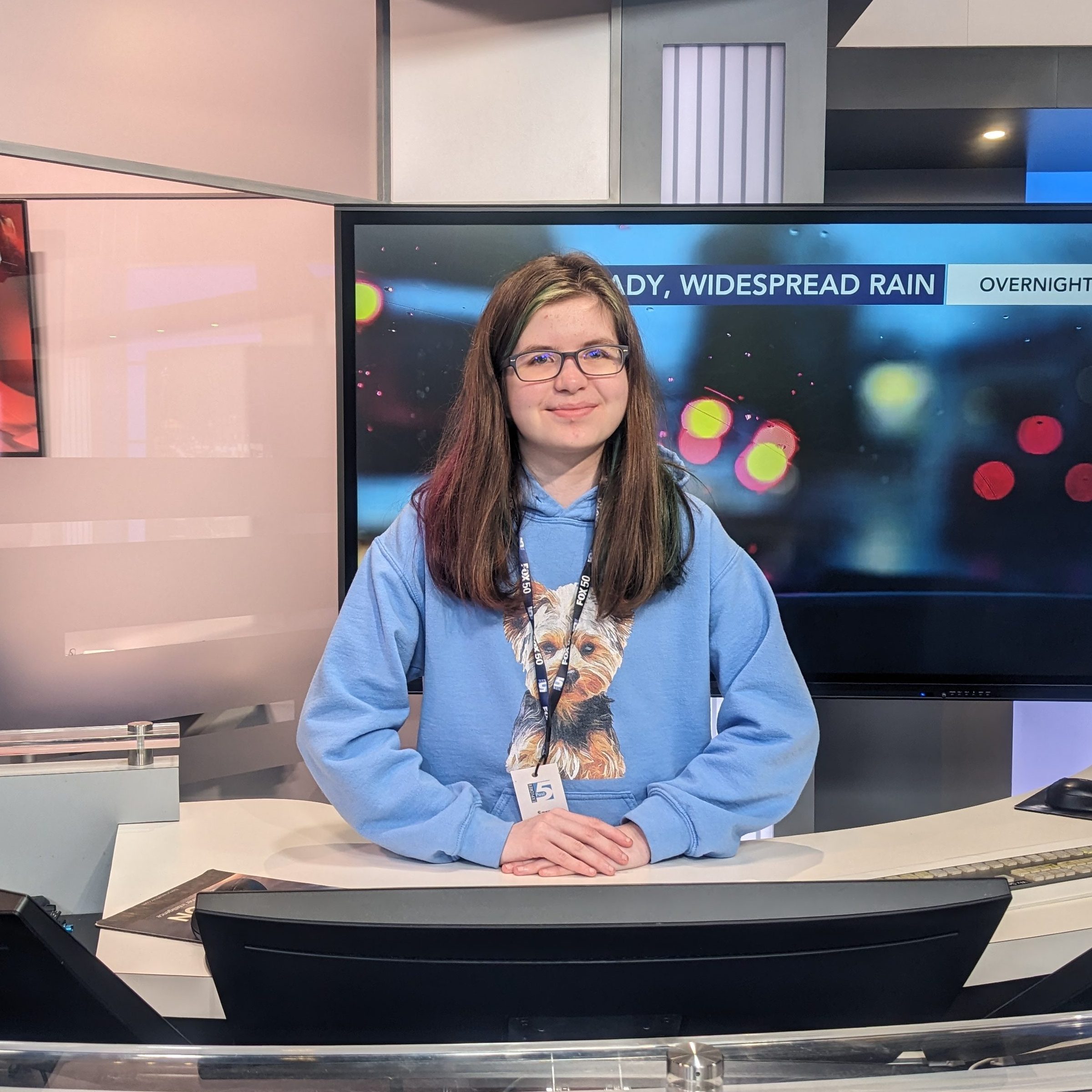
I hope to go into journalism either with a small company or with NPR over the radio. I’ve been writing for my Newspaper “Fuquay Varina’s Roaring Bengal” since freshman year. I’ve written about faith, to infrastucture, to school events. I know a lot about boats, space and planes because of these articles. My most notable works are my JDRF (now Breakthrough Type 1 Diabetes) walk article and my four part series on the different religious holidays in spring. I was a part of a workshop called Post 5 where I worked with WRAL, a local news station in North Carolina. I got to see broadcast journalism. I learned a lot from them, especially what I want to do and what I don’t want to do.

I am a writer with a book published on Amazon. I write fantasy war stories, mixing religions (hints: my own faith) and cultural stories where I create a whole new place. I also work on the sci-fi and romance genre which can be difficult. One has many of many ideas but no plot. I’ve made tons of maps out of rice and don’t have enough stories for them. I use what I got from my day for some of my stories especially if someone does something particularly funny.

I love dogs. My yorkie-poodle, Tessa is my little sister. I’m an only child of only children so the dog is worth it. I got her in fourth grade after fostering many other dogs from boxers to terriers. Tessa’s full name is Pequina Tessora Trouble Anderton. Her first name is Spanish for little treasure. Spanish names for dogs are a trend in my family. When I was a baby we had a dog named Quesi (Kacy), short for Hermosita Quesi which means definitely cute. We foster with Second Chances Pet Adoptions. I’ve fundraised for them with my school’s Pet Parade. I wasn’t the first with the idea but I continued it and I hope that another shelter gets money from the parade again.