How to help the uncounsious

Imagine someone in your class or work place suddenly collapsing to the ground. What do you do? Do you call for help? Do you give them water? Do you just stare and hope they wake up? 

“I want people to talk to me and remind me that I’m safe,” said Alondra Pagan-Galarza, a high school student who has functional neurological disorder, which causes her to have functional stress seizures. “Distract me from the situation, talk about something random. Others like to be left alone but I like the social aspect, I like physical contact. I like to know that people are there.”

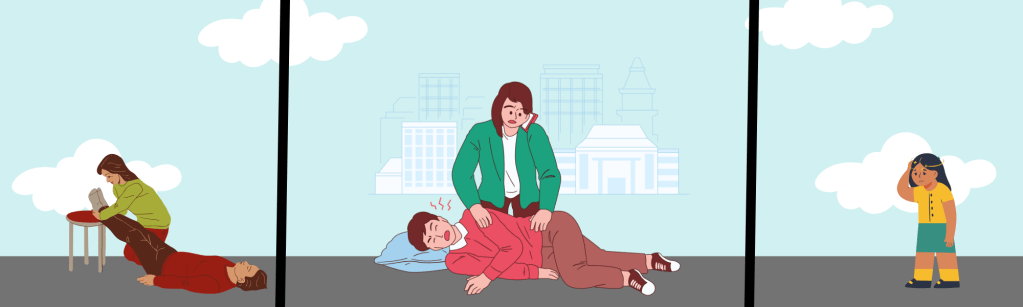
According to UNC Health Talk, if a person has a seizure they should lay on their side and have their head supported with a pillow. Blankets, jackets or keeping their head up with one’s hands can work as long as one’s head isn’t being hit. Don’t restrain them if one is holding them. Those who faint should be laid on their back and their legs should be above their heart. It’s a good idea to loosen tight clothing or necklaces so blood can easily move. 

People want someone, not a group, with them when they pass out just for some peace of mind. It comforts others to know that someone cares. At the end, let them get up at their own pace and then get some fresh air. Give the person some water and some food to recover after the episode.
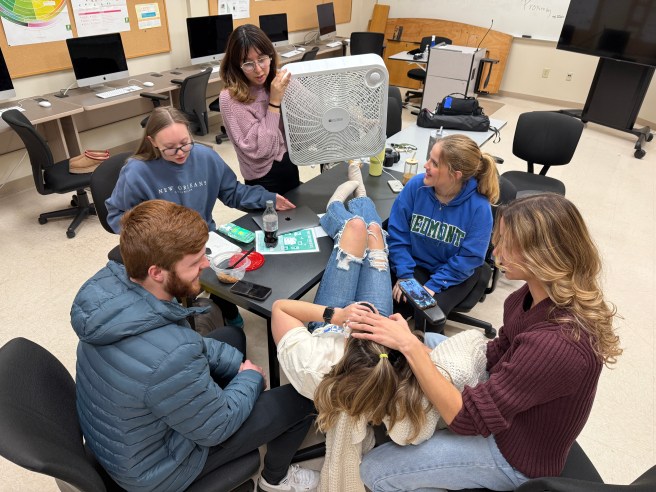
Maggie Bishop, a student at Piedmont University in Georgia, was diagnosed with Tachycardia and PNES (Psychogenic Nonepileptic Seizures) which creates psychological seizures. “Sometimes people don’t know they have this until it [a person passes out] happens. Knowing what to do if someone does have one is beneficial. You never know where you’ll be when it happens.”

Fainting and seizures have their similarities and differences. Fainting usually is for less than 30 seconds, whereas seizures can be three minutes. Seizures could be small with very little movement to large movements. Fainting can have some shaking and their body can move slightly.

“A good analogy of FND that a lot of people use is a computer,” Pagan-Galarza said.  “A computer works right, the hardwares works right, everythings good. All the buttons click but the software is what doesn’t work. It’s inside the computer and you can’t see it.”

According to Patient, four out of 10 people will faint once in their lifetime. This occurs when there is a drop of blood pressure and blood can not make it into the brain. It can be caused by heat, standing for long periods of time, stress or fear, having little salt or fluid or even standing up too quickly. There are reflex, cardiac, orthostatic and neurologic syncopes. Reflex syncope is most common with vasovagal, situational and carotid sinus. Teenage girls and older adults are the most likely to faint. 

“When I actually have a seizure I shake, zone out for like 20 seconds and then I jump but for some other seizures I might shake and I might be paralyzed because that is one of my other symptoms,” said Pagan-Galarza. “When I wake up my brain is still foggy. It’s still confused and I need a minute to process because it’s [brain] been through lots. It’s not any electrical signals, the seizures are not epileptic and don’t cause brain electricity. It’s due to stress and anxiety.” 

The World Health Organization says that 5 million people are diagnosed with epilepsy each year. Seizures can also be caused by brain tumors, brain injuries, infections, fevers or electrolyte imbalance. Menstruation, stress, some medications and lacking sleep can also cause someone to have a seizure. There are different kinds of seizures: absence, tonic-clonic, myoclonic and atonic. There are also functional seizures where it looks like a usual seizure, but is not caused by the extra electrical brain activity like the ones above. 

“I’ll get light-headed and my legs will start twitching,” Bishop said. “My friends have noticed that my eyes start twitching. I don’t notice it because normally I’m already out.”

Not everyone, especially if they have passed out before, wants an ambulance to be called. Hospitals can give a diagnoses of why one fainted and give some things to help. Rescue medications can stop a seizure but sometimes they are stress based and going to the hospital can cause more issues. Listen to what the person wants unless they are in danger.

“I pretty much tell everyone to watch my head so we don’t have to call an ambulance when I’m having a seizure,” Bishop said. 

According to the CDC, it’s important to call 911 immediately if one isn’t breathing, can’t be woken up after a minute, has had a seizure for longer than five minutes or has a head trauma. If it’s their first time having a seizure or fainting, calling a doctor is advised. Always search for a medical ID band that can give one information on how to help that individual.

“It’s important [to learn] because you don’t know why they’re having a seizure,” Pagan-Galarza said.  “It could be epileptic, it could be non-epiliected. It should be widely known especially for FND because it’s not a well-known condition, even though it’s the second most common neurological condition. People need to know if an epileptic seizure happens for five minutes, you call 911. Your brain is getting bad electrical signals. For FND you don’t do that because it’s caused by stress. Stress doesn’t go away in five minutes.”
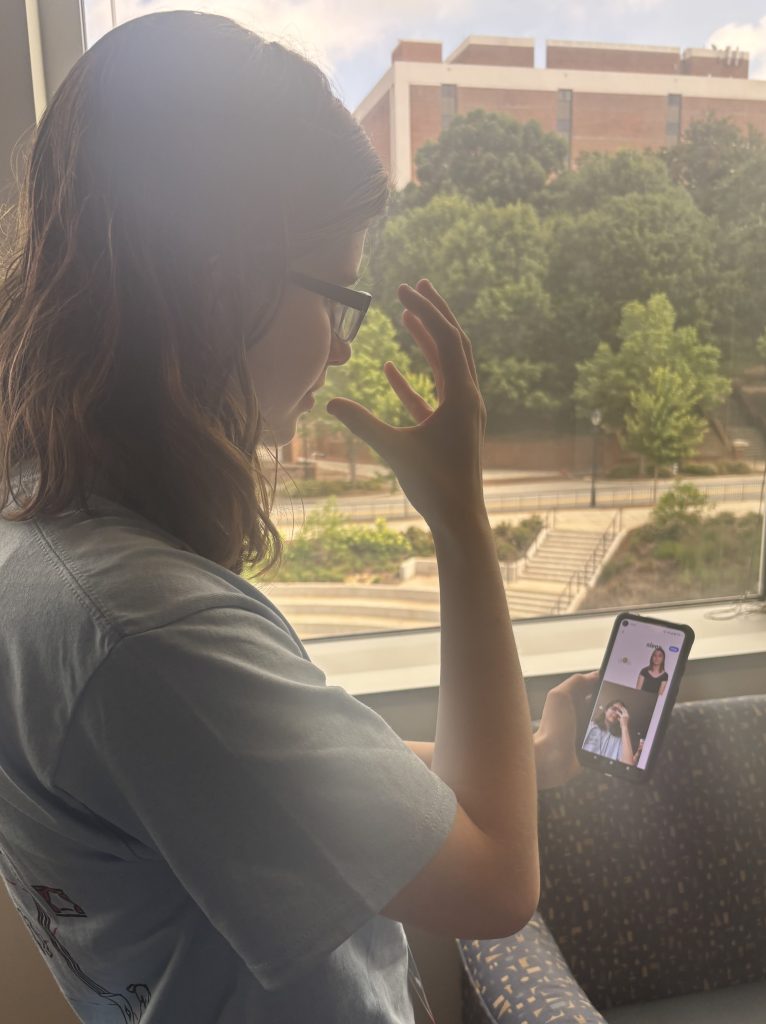
Why American Sign Language is important

Made by: Maggie L
A student learns ASL with an app called PocketSign

Sign language is very important for our world. I have a close deaf friend my age who wears cochlear implants and a deaf adult in my life who mainly signs. This language is also good for when you need to be quiet but still want to talk to others. ASL is a real language with its alphabet, grammar rules and even poetry. 

As the ASL President at Fuquay Varina High School in North Carolina, I know it’s important for people to learn some signs so they can talk to a larger population. Some signs also travel across languages, even though American Sign Language and British Sign Language are different. 

More than 4,000 children are born deaf, according to the Dallas Hearing Foundation. The World Health Organization says that 2.5 billion people will have some degree of hearing loss in 2050. NIDCD says that 15% of adults report they are losing their ability to hear, and one out of three people from the ages 65-74 have hearing loss. 

Some people with neurological disabilities can go selectively mute. Knowing sign for events like these help people feel heard when they are too scared or overstimulated to talk. So with this information, learning sign language is good for the community. 

Sign language is needed for the deaf, mute and families of deaf people. It’s a crucial part of deaf culture that can create beautiful words. Some people don’t believe sign language is a real language because it’s not vocal, nor does it have a writing system. There have been languages before that don’t have a writing system along with the fact that people can understand each other. 

So learn some ASL. Just learning little phrases is a good start. There is a whole new world that you can talk to and the community will love that you want to learn. Search up online or on social media about events near you where you can learn sign language. 

How Do Tests Affect The Mental Health Of Students?

by Madison McKenzie
Academy for Advanced Studies
McDonough, Georgia

With teenagers facing multiple mental health challenges, the plethora of testing required in many schools can be overwhelming for  students. 

Rudi McKenzie, a licensed clinical social worker who works primarily with women who suffer from depression and anxiety, said testing can cause high anxiety for students, especially for those already suffering from mental health issues.

“From a counseling standpoint, what I see with different clients is how test taking can impact identity, how you see yourself, the pressures that the society, your family, your friends and your close circle can put on you,” McKenzie says. “As far as, ‘If I don’t do well, how will they see me? If I don’t do well, they will see me as a failure.” 

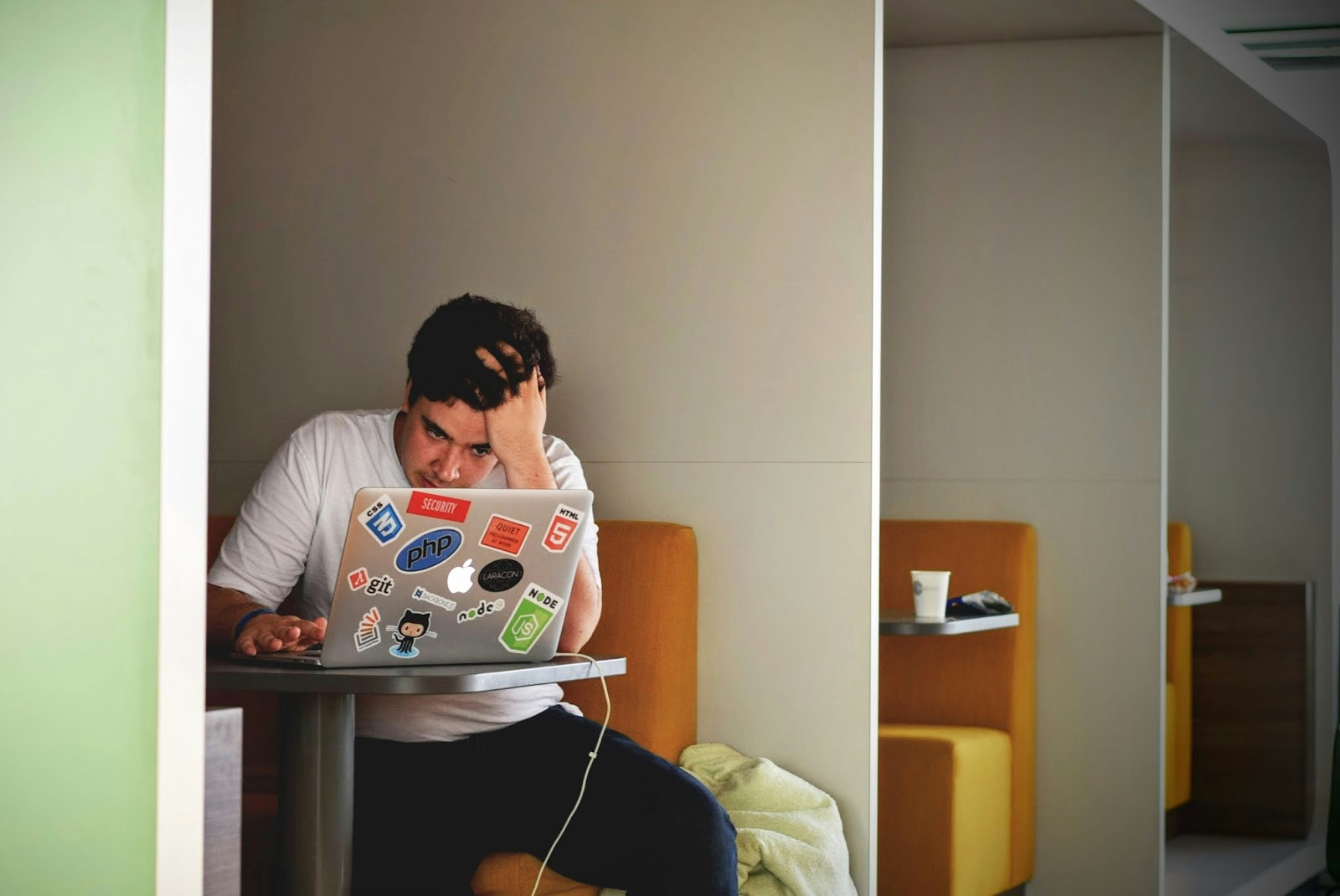
Christopher McKenzie, a former part time lecturer at Kennesaw State University in the Wellstar program, said he saw that anxiety firsthand with some students. “By testing the knowledge that they gain throughout the course of the semester, that anxiety comes up in various forms,” Christopher McKenzie said. “Whether it’s them saying they are not going to show up to class today, or saying that they are going to panic.” 

Christopher McKenzie, a former lecturer at Kennesaw State University, noticed that some of his students struggled with test anxiety.

In his time at Kennesaw, some students would have some sort of anxiety when it comes to testing, or just homework in general. This would be because students are afraid of failure and have the fear of disappointing, McKenzie said. This can lead to panic attacks, shortness of breath, chronic worry, difficulty concentrating, a lack of sleep, and mood changes. Food habits can also be impacted. 

Depression also comes into play. This is because so many things are coming to one’s mind and so many things within an individual  are changing as well. A lot of tests can really make or break somebody. If a person is a bad test taker, that is also more stress and anxiety on a student or even an adult that is trying to go back to school. 

Rudi McKenzie would see some of these students in her practice.

“I think on average, If I had 20 students on my caseload, more than half have been impacted in some form mentally by testing, anxiety, or testing impacts,” she said.

There are healthy approaches to help a student succeed. Student services and counseling services are some ways that students can get the testing accommodations that they really need. Students that make what they are going through known to a trusted adult can most definitely get the help that they need. The other side is there are other students that are maybe afraid to ask for help because they don’t want to seem like they need somebody to depend on. They could also be afraid to speak out about how they feel because they are scared that they will get turned down. 

“Address the thinking,” Christopher McKenzie said. “It is important to address irrational thoughts, and those irrational thoughts can really turn into a gambit of ideas and things like false beliefs. It is important to have a safe space to address any false belief, help create emotional wellness or well being.” 

Rudi Coleman, a licensed counselor, said that people should be aware of how anxiety impacts them.

Rudi McKenzie said that recognizing that there are steps a student can take to improve their own mental health is critical to overcoming anxiety. “We are all responsible,” she said. What I’m thinking, what I’m going through is different than what you are thinking and going through. Even though we share similarities we are also two different people.” 

Despite the differences between people, Rudi McKenzie said confiding in friends and others who share similar feelings can be helpful in overcoming anxiety.“Make sure that you have a community in which you can relate to or share things with, especially communicate with,” she said, adding that it’s important not to focus on comparing your experiences with others. “Comparison can be really dangerous because you can get in your head and think that you are the only one thinking something and that something is wrong with yourself.” 

Acknowledging that your anxieties are natural is critical. “Remind yourself that your thoughts, your feelings, your emotions, are important and very meaningful.”

If you are experiencing mental health concerns, call 988.

Are devices stunting childhood development?

Photo by Robert Collins on Unsplash

by Emory Miller
The Burlington School

Summer is the perfect time for playing outside, riding bikes with friends, or even heading to the neighborhood pool. 

Unfortunately, many children are likely to be found indoors in front of some form of electronics.

Today, technology use has increased significantly as it has moved from adults to teens, and from teens to elementary students. Not only are elementary students being put in front of screens at school to learn, but many are also immediately put in front of a screen when they get home as a form of entertainment. 

Children may initially be given electronics for purposeful reasons like learning new information, increasing vocabulary, and developing math skills. However, electronic usage can often become a strategy for parents excessively, resulting in negatively impacting the overall development of children.   

There are many technological advancements that children are increasingly given access to from a young age. 

Researchers stated in a study, that “96% of Americans have a TV and 94% of children ages 3 to 18 have internet access through a computer or smartphone.”

This has led to a negative impact on school performance, social skills, and overall physical fitness of youth across the United States. 

“If young children spend most of their time engaging with an iPad, smartphone, or television, all of which are highly entertaining,” Dr. Jennifer F. Cross, a child behavioral specialist, said in the Journal of the American Medical Association of Pediatrics. “It can be hard to get them engaged in non-electronic activities, such as playing with toys to foster imagination and creativity, exploring outdoors, and playing with other children to develop appropriate social skills.” 

Kristi Tanner, Dean of Students at The Burlington School in Burlington, North Carolina recognizes both the personal and professional impact she has seen as a result of increased screen time. Tanner’s children, like many others, turn into zombies when watching an electronic because they are consistently staring at a screen. 

Tanner has seen that screen time is being shown to affect her children’s creativity. Tanner said, “My own kids love to play pretend and make up new situations, school, restaurant, coffee shop, etcetera, but when they watch a show all of their imagination freezes.”

Many children who are addicted to screens are limiting their social skills and are then limited from having impactful conversations. This hinders children’s abilities to connect with others, unlike children in the past.  

Heather Gibson, a teacher at Providence Christian Montessori, a school in Burlington, North Carolina, said, “I find that the children that have less time on a screen have a higher conversation level. They are able to sit and talk with their families, reason through, and have real conversations.”

When children participate in different kinds of play, for example, sports, walking the dog, or running around the playground, they learn so much more than watching something on an iPad, computer, TV, and other electronics. Harvard graduate Leah Shafner stated in Summertime, Playtime, “In play, children learn to navigate their physical and social environment, while also imagining and constructing new realities. They practice solving problems, testing out how to love, what is wise, and what is safe.” 

The impact of overuse of electronics additionally impacts children’s performance in school. Tanner suggests that as an educator she has observed how resourcefulness and resilience across the board has decreased, and that she believes this is correlated with increased screen time for children. 

“Students want immediate feedback and need lots of reassurance, significantly more than 15 years ago,” Tanner said. 

The need for immediate reassurance leads to children finding it difficult to fend for themselves, Tanner said. Children rely on other people to create their own ideas without having to use their own imagination.

Additionally, Gibson, discusses how when families of children took away leisurely electronics for one month parents and teachers saw a vast difference. 

“Those children were more in tune in class, more thoughtful, and better at problem-solving.”

According to Charles Nechtem Associates, teachers now are starting to plan shorter lessons for their classes. This is because by watching screens or being on electronics, they are prone to become easily distracted, which then results in not being able to stay focused for a long period of time.

Excessive screen time almost immediately affects the child’s ability to watch and understand the everyday involvement which they need to understand the world better even from a young age. But sometimes being addicted to an electronic can change a child’s sense of reality, decreasing their understanding of the world even from a young age. 

Richard Frampton, an elementary school physical education teacher in North Carolina, believes being on an electronic computer can change a child’s sense of reality. 

“Unless a parent sits down and talks to the kid about the games or videos they watch we have a false sense of reality,” Frampton said. “If they are playing a game where they kill people if it is not explained in the world that there is no reset button, there is no new game.” 

Frampton has seen that being on an electronic for extended lengths of time greatly decreases children’s physical activity.

“That’s one of the really negative things about electronics is that kids get addicted so quickly. One more show turns into another, then another, then another one. You finally reach the point of being addicted,” Frampton said. “Because they get so addicted they never step outside or never move their bodies which is honestly harmful to their overall health.” 

In order to counteract the negative effects of the overuse of technology, Providence Christian Montessori decided to make their students spend over 1,000 hours outside during the school year.

“There is so much to gain from being outside. Our bodies need the vitamin D to help process the calcium and magnesium which helps kids grow,” Gibson said. “Being outside helps children with a better sleep schedule, lets the children get their energy out, and just overall have a fun time enjoying nature.”

By having extra time outside children learn from mistakes but also have guidance as needed. Not only does playing outside help problem-solving skills, but it also helps with development and communication with other children since “playing means noticing social cues, listening, and taking another’s perspective,” Shafner stated in a study. 

While some will say there is a need for screens and others will argue that screens will never be good for child development, there must be a balance between screen time and playtime. Children deserve to physically experience the world and need to be encouraged to ditch the iPad and play outside. 

Overburdened, Overloaded, Overworked: The increase in academic pressure for high school students

by Cora Williamson
Durham School of the Arts

Didn’t you hear? Exceptional is the new average. Students taking advanced placement classes are no longer ahead, and a 4.0 gpa is the norm. It takes more than rigorous academics to be considered a good student.

“You get the highest GPA, you do everything,  all the clubs, you get all the grades, you talk to teachers, you get letters of recommendations for all you go to all the different clubs, you do all these extracurricular activities,” Said Jaydon Jones, rising Senior at Durham School of The Arts in Durham, North Carolina. 

With a drop in college acceptance rates, and a rise in academically outstanding students, the pressure is on for teens to go above and beyond in every aspect of their school careers. There are a lot of public universities that have become increasingly selective, most of them favoring only the top 10% of each class. 

In 2016 the University of North Carolina Chapel Hill had a 26.9% acceptance rate which has decreased to a concerning 17.7% as of 2022. In more prestigious schools such as Duke, Dartmouth, Columbia, and Vanderbuilt there were percentage changes as large as -59% between 2014 and 2024. 

With such stress inducing statistics, students around the nation have increased their AP courses, some taking as many as eight a year.

“ I don’t want to take something I’m not interested in. But now I’m like, if I had done that, I would have had a higher GPA, even if I wasn’t interested. So it’s weird… There’s definitely pressure to take classes you don’t want to take,” Said Norah Lubeck, a rising junior at Riverside High School in Durham, NC. 

Norah Lubeck is one of the many students that go the extra mile and still feels behind in the race. Going into her junior year she is taking eight AP classes and three community college classes. Piling on 11 college level classes just to get a slight leg up. Yet she still feels that because she chose electives of interest  in freshman year like photography and psychology instead of AP electives, she’s fallen below her peers. 

“ I do have good support, but I also would say it could be better, because, for example, right now, I’m in the house all alone. Pretty much. And I can’t get outside. I can’t go and do things,” Jones said

According to statistics from Mental Health America, more than 4 million high school students experienced a depressive episode in 2022, and over 2.7 million high school students are experiencing severe depressive disorders. Balancing a social life, impressive academics, outside achievements, and sports, while experiencing hormonal imbalance is a lethal combination, and yet, it’s the expectation. 

 “People say, ‘ Oh, you don’t need to take APs. Oh, you do. Or like, Oh, you should follow your interests.’ And then some people are like, ‘Oh, you need to have a specific track’. But if it’s not AP, it doesn’t matter.’ Lubeck said. “ People are just saying so many conflicting things that it confuses you on what you need to be doing. And I think that distracts from what you want to be doing, which I think is the most important thing.” 

It’s a familiar peril among almost every student to feel deterred from their passions because they move all their energy into doing anything they can to make themselves stand out to colleges. 

“Thinking forward, I want to go to college, and I have no idea if what I have right now is good enough to get me into a college I want to go into, especially compared to people who may be at the top of the class.” Lubeck said. 

A large contributor to the weight burdening students is the ambiguity of what colleges are looking for. It’s often drilled into young minds that you need to be ahead in STEM courses, participating in at least one sport, earning some sort of leadership spot and volunteering, all while maintaining a 4.0 GPA. But depending on the college some may not accept certain AP credits, and being in too many extracurriculars can be seen as noncommittal. 

“The pressure comes from all sides, and you have no idea if what you’re doing is enough. And you just gotta keep doing more even if it’s brainless work.” Lubeck said. 

Showing Pride: Athens allies show support of community

by Madison Connor
Hebron Christian Academy

“We have to be visible, we should not be ashamed of who we are,” said Sylvia Rivera, a prominent gay rights activist and leader of protests and Stonewall, about pride.

While said 22 years ago, it is still felt by many. Another reason why many feel they should not be ashamed is because they believe that their sexuality is not a choice. This is very similar to how ethnicity is not one’s choice, and we as a society know it is wrong to disregard or hate someone because of something they cannot control. However, this is not the case for many in the LGBTQIA+ community.  Yet, businesses can help overcome these discriminations they face by simply being welcoming.

“I think it’s imperative, it’s more than important, I think it’s necessary,” said Jo Thomas Wilson, a small business owner and operator of My Heart Salon in Athens, Georgia.

WIlson believes it is necessary for businesses to be welcoming, especially towards those of the LGBTQIA+ community. The reason why is that Wilson, as a queer business owner, feels that it is integral for those of the gay community to want to feel loved and welcomed, and that welcoming and loving members of that community pays off.

“The LGBTQIA+ community is willing to spend it [money] in places that see and support them… if you don’t want to support me then I think you don’t want my money, I’m gonna spend it somewhere else,” said Wilson.

Another reason why Thompson believes it is necessary to support the community is because of monetary opportunities. He said that if the community feels it is not welcome, they will not spend their money in that place, and from a business perspective, it is an avoidable loss of profits. 

But, for those who are looking to support the LGBTQIA+ community, Wilson has advice.

“They could hire people like myself to help facilitate these kinds of conversations considering I have a lot of experience, when we hire people who have lived through experience, that’s when we learn the most,” says Wilson.

Wilson, who believes that in order to be truly welcoming, said it is necessary for the company to be willing to hire those who identify as LGBTQIA+. The reason being that with members of the community on your staff, you learn and develop as a business from them. The personal experiences they bring helps provide insight into how to be welcoming to others in their community, making the overall environment a much healthier space. However, the inclusivity and support should not stop there.

“We ask them for their pronouns, we also ask if they have any sensory issues so we can accommodate for that. We have a form with every booking that offers help to get inside for those with physical disabilities and we donate to personal and organizational causes,” said Wilson.

Wilson believes that there are many other methods companies can use to be welcoming, and he listed a few methods his company uses. While some of these methods might not be applicable for every business, there are some methods that can be used for nearly every business. Simple practices like asking for pronouns and helping those with disabilities inside is something any business can do, and while it may be a small act, it will be greatly appreciated by many. 

Being welcoming pays off, literally. Businesses can also make efforts to be welcoming by hanging a pride flag or advertising as LGBTQIA+ friendly. This is something that My Heart Salon does, and it is a big step for businesses who have not done so before.

ChatGPT negatively impacts journalism industry

Photo Credits: Crew via UnSplash

by Jadyn Barrow
Druid Hills High School

New technology and innovations are made each day and some become beneficial to the world and some don’t. ChatGPT is an AI tool used to assist humans and it was made on November 30, 2022 by OpenAI. With the creation of ChatGPT, more and more people began to use and rely on AI. Whether it was answering a simple question, writing a school paper or writing a paper for work. Although it was beneficial to some people, it’s deeply affecting my future and fellow journalists in many ways.

One of the main issues is that people claim the work of AI or ChatGPT as their own. As mentioned in Mashable, literary magazines, such as Clarkesworld, have been having issues regarding ChatGPT. When they were accepting submissions, they noticed that forms of AI were used to write literary pieces, which limits the creativity of the writer. I have noticed that when writers use ChatGPT, their work becomes boring and has no creative features, hence a robot is writing it. 

“What’s so important about journalism is following our journalism ethics and making sure things are factual and accurate,” said Kayla Renie, Newsroom Adviser of The Red & Black. “And when ChatGPT makes those mistakes, it puts a bad tone on journalists. So, I think as a whole, it could be confusing. Did a real person write this, did a journalist write this, did a member of my community write this, or was this a computer compiling all this information.” 

Photo Credits: Freddy Kearney

Fellow people have similar thoughts as myself, and it’s not limited to just journalists. Rodolfo Delgado wrote in Forbes, ‘As writers, our distinct voices and authenticity are what draw people in. Reflect upon the individuals you follow or enjoy reading about. More often than not, you’re drawn to them because you resonate with their thoughts, their persona. As a writer, if you heavily rely on AI to improve your grammar or refine your ideas, you risk losing yourself in the process. Consequently, you stand to lose your readers and followers.’ 

Therefore, when writers use ChatGPT work as their own, it looks bad on them and makes them look lazy and untalented. “Journalists are speaking for what’s taking place, so that our readers can be educated and connect, and AI doesn’t do that, it takes images from anywhere and creates images and things that are not unfolding in front of you; it’s literally the opposite of photojournalism,” Renie said. “We need real people to document because a computer can’t do that with emotion, with honesty and connection to educate, it’s just created from the void.”

A potential fear that occurs in the journalism industry due to the creation and use of AI is if it will eventually take the jobs of journalists. AI continues to “improve” every time it’s used and if it keeps getting smarter, there’s a chance it could be able to destroy the journalism industry. As a future journalist, I don’t want ChatGPT and other AI tools to take my career away because I believe it would be unfair and human writers are better as a whole than robot writers. Thankfully other journalists have the same fear as myself that AI is out for their jobs. 

“Journalism will always have an importance and matter,”  said Renie. “You can’t set aside the value of face to face journalists, journalists being members of the community, and getting your information from a real person, somebody who’s trustworthy. I think where AI could infringe on journalists’ jobs would be copy editing or doing quick pieces.”

Many people including myself believe that forms of AI, such as ChatGPT, are negatively affecting the journalism industry as a whole, limiting the critical thinking skills and creativity of writers and taking over their careers. And for everyone else, AI causes dependency, which will cause people to lose their sense of creativity.            

Are Underage Drinkers More Prone to Risks Such as Developing a Substance Use Disorder?

Photo Credits: Adam Wilson

by Jadyn Barrow
Druid Hills High School

Each day, more and more underage young adults continue to be involved with the use of alcohol, whether it was due to peer pressure, stress, or problems regarding mental health. With more involvement, this leads to a higher chance of developing a substance use disorder. According to American Addiction Centers, 9.7 million young adults from the ages of 18 to 25 dealt with a substance use disorder.

According to National Institute of Alcohol Abuse and Alcoholism, a factor of young adults developing a substance use disorder is that they are unaware of the potential risks. Some of the risks include changes in brain development, alcohol poisoning, long-term effects on heart, lungs, pancreas, and kidneys and increased deaths and injuries. If more young adults become aware of the risks that come from drinking early on, many instances of underage drinking could be prevented. 

One problem many young adults don’t realize is that their surroundings can have an influence on their decisions. In situations where everyone is drinking, it’s easy to fall under peer pressure and the drinking habits of others can impact the underage. According to Cleveland Clinic, a 5% increase in adult binge drinking leads to a 12% increase in the chances that the children or teenagers around them will drink. 

With that being said, whether it’s involving drinking or not, your surroundings and peers tend to hold an influence on you. 

Researchers said in the NIAAA, “Evidence suggests that the most reliable predictor of a youth’s drinking behavior is the drinking behavior of his or her friends. Many research–based interventions target the child’s relevant behavioral skills, such as his or her ability to react appropriately to peer pressure to drink, as well as his or her knowledge, attitudes, and intentions regarding alcohol use.”

Many health consequences come with underage drinking, and that can vary from poor health issues as severe as changes in brain developments. Because the brain continues to develop into your 20s, the use of alcohol before that can mess up the full development. According to the NIAAA, underage drinking can ruin the brain structure and functions, such as causing learning problems. Due to this, the brain wouldn’t be able to function properly compared to the brain of a young adult who didn’t participate in underage drinking.

Photo Credits: Robina Weermeijer

Along with physical effects, underage drinking affects the emotional and behavioral well-being of an individual as well. The National Library of Medicine stated that involvement with alcohol at a young age can cause low self-esteem, depression and suicide. And it’s more common for mental health problems to occur in those who use alcohol at a young age. 

Dr. Avani K. Patel, a psychiatry resident at the University of Mississippi Medical Center in Jackson, told the American Medical Association, “It can also worsen your psychiatric disorders if you’re experiencing anxiety or depression,” or even post-traumatic stress disorder (PTSD), she said. “It actually worsens PTSD and can be associated with other substance-use disorders, so you may pick up another substance to supplement what you’re already doing.”

Many people have different beliefs whether underage drinking is harmful to young adults or not. However, there are potential risks in underage drinking and it’s best to be aware before participating in such activities.

Surgeon General Takes Stand on Social Media 

by Grace Bennett
Oxbridge Academy

Social media is a dominating factor in people’s lives, especially teenagers. This domination has sparked the debate on whether social media should bear warning symbols like those on drugs and alcohol. 

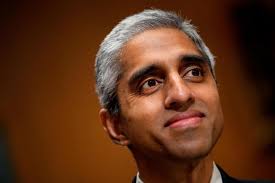
“The mental health crisis among young people is an emergency — and social media has emerged as an important contributor,” Surgeon General Vivek Murthy wrote in a guest editorial in The New York Times.

Murthy feels strongly that social media is just as harmful to children as drugs and alcohol; he demands they be labeled and placed in the same category. Murthy presented his case to Congress with a firm belief that they must protect the children of America. 

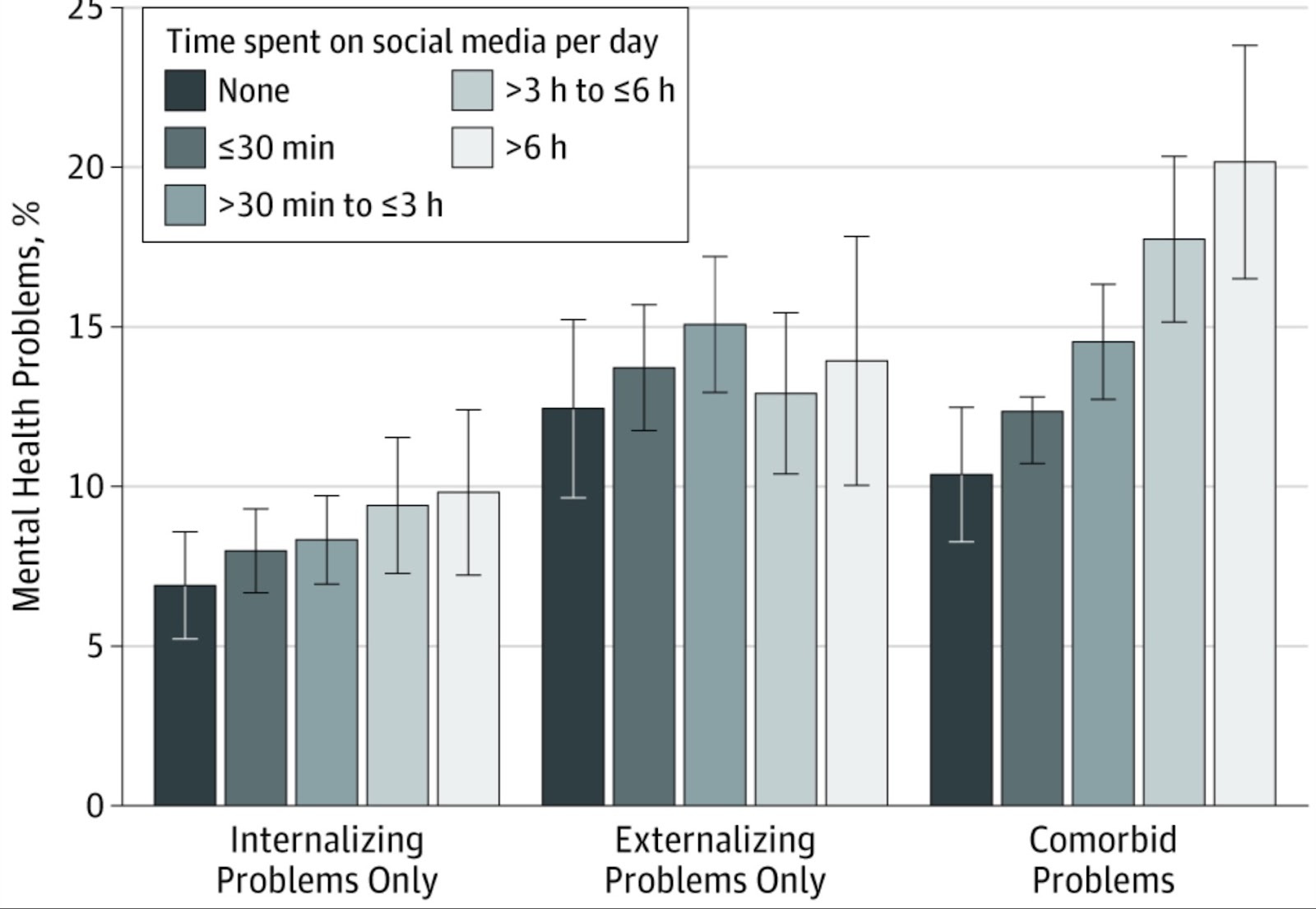
Graph from JAMA

 According to a CNN article, Murthy said, “The threat social media poses to children requires urgent action,” and he demanded Congress to put a label on the apps as it does with cigarettes and alcohol.

Murthy cited multiple studies showing that the more time teens spend on social media, the more likely they are to deal with depression. Murthy is passionate about warning parents of their child’s struggles due to social media. 

Murthy is not the only figure who believes social media is an epidemic for children in America right now. Sandy Hook Promise CEO Nicole Hockley, who successfully won a multimillion-dollar lawsuit against social media conspiracy theorist Alex Jones, also supports a warning label. “Young people are biologically more vulnerable to social media influencers and advertising, and more likely to engage in impulsive and risky behavior.” 

“We stand with the US Surgeon General on requesting a warning label and demand bipartisan action to regulate the content that youth under age 18 are exposed to online,” she said in an interview with Mother Jones. 

Social media has been a topic of discussion for decades now. Doctors are not the only people who feel it negatively affects children. Monis Alam, a social media expert with the Council of Fashion Designers of America, said it is designed to be addictive. 

“As social media experts, we focus and obsess over our audience, crafting stories and chasing viral content for engagement. It is safe to say that we must protect our youth against marketing tactics whose sole goal is influencing them to engage and transact.”

Catherine Bennet, a teenager’s parent, said she shares people’s concerns about social media’s impact on children. “As a parent, I’m deeply troubled by the data on the effects of social media on kids and teenagers. I support the Surgeon General’s call for warning labels on social media platforms — and tools parents and educators can use to help protect kids’ privacy, safety, and mental health, which is helpful.”

After the many news reports and evidence presented by the Surgeon General and others, it is apparent that social media will create a more considerable downfall if warnings are not implemented soon. Parents and educators must be made aware of the issues presented to Congress. Murthy is confident legislators will pass bills, and the children of America will be protected. 

Photo from ABC12

“I put forward this call for a warning because I think it’s essential that parents know what we now know,” he said, “which is that there are significant harms associated with social media use.”

Flash to the Past: Grady Camp evolves

The beginning of Grady College high school summer camp did not start with the Georgia Center. It was an independent camp for 37 years and only coordinated journalism classes.

“We had been running the journalism academy for more than three decades as a college independently.” Dr. Joe Dennis said. “One of the goals that I had when I was a director was you getting some freedom to explore because part of the experience is getting to know the campus.”

Prior to working with The Georgia Center, the camp’s name was The Georgia Journalism Academy.This Academy was established back in 1982. Dennis was the director from 2005-2015. He explained his technique and goals on how he led this camp for 10 years. Dennis tried to give campers time to explore and have time for themselves. Freedom was needed for the classes itself, as students conducted interviews with professors, students, local businesses or citizens in Athens for research about the pieces they were writing.

“The whole camp was a journalism camp and the classes were broken down into different beats of journalism,” Dennis said. “If a couple students needed to go across campus to interview whoever, we could call up one of those eight counselors to transport them.”

The Georgia Journalism Academy was run by 8-10 undergraduate students to take care of the campers. They would live with the campers in the dorms and help transport the campers all around campus. Since it was a journalism camp, campers would go and interview people for their stories. These stories could be anything from sports to features to editorial writing. Broadcasting, photojournalism and advertising were also offered.

 “Some of the people who have gone to this camp are now in big places, who work in media in CNN, ABC,CBS, doing PR for big companies now,” Dennis said. “I think the camp was a huge influence for high school students to see what their interests are early on to help them figure out what they want to study when they get older.”

This program offered six types of different journalism genres to study and explore.The more campers learned about the majors they could study, the more it helped with their long term career choices. Real people who have experienced this camp are now a part of huge companies and are thriving in the journalism field.

“If there’s any student who’s on the fence on whether they want to be a part of journalism, they need to come to this camp because it just furthers that passion” said Jack Patterson, a former camper. “The curriculum was awesome, I learned so much from my professors.”

Patterson went to the journalism camp in 2008 and 2009, and is now a professional journalist working as a sports anchor and reporter at CBS-affiliate WRBL News 3 in Columbus, Georgia. Patterson described his time in Grady camp as “Incredible. I have friends from the camps that are friends for life.”

He also explained the activities he got to experience: bowling, go carting, exploring the campus, and a banquet in the press box at the UGA Stadium. Patterson offers some advice to current campers: “Be resilient, there will be so many no’s but you have to bounce back.”

The camp has changed significantly since Patterson attended, in part due to its partnership with the Georgia Center.

“The Georgia Center runs the logistics so the dorms, food and activities,” said Stephanie Moreno, scholastic journalism outreach coordinator for Grady.

One thing that has changed due to the partnership is the out of class activities, which are no longer run by Grady. In a sign up sheet for the camp published in 2015, it showed that camp activities included rollerskating, a cookout, a pool day, a closing banquet and other outdoor activities.

Compared to that schedule, some of this year’s campers say that the current camp feels “unorganized” and “restricted”.

“I wish I would’ve know how strict the camp would’ve been before I signed up for it,” said Adriana Acevedo, a 2022 journalism camper. “It just felt like there was so much miss communication all week.”