Going into the second semester of school, I often feel jarred choosing between one of the many sports being offered. The question comes to mind, “Why can’t some of these be moved into the fall semester.” Well, being in the south that answer is always football, the most popular sport. This is understandable because it brings in the revenue and all, but shouldn’t there be a way to not make multi sport athletes have to choose between Track and Field, Baseball, Soccer, Tennis, Softball or Golf?
All of these sports are able to be played in the fall semester except for soccer which would invade Football since they play on the same field.
The window to play multiple enjoyable sports for many athletes is thrown out the window by most sports being crowded into the spring season. Since less than 1% of young athletes will make a career out of playing sports, the focus should be on opportunity to enjoy and play sports. Expanding on that topic, we should allow for multiple spring sports to be played in the fall season.
I obviously understand that football will always be a priority, but restricting athletic potential and forcing kids to play one sport and making them make the hard choice of which sport they need to cut out of their high school life is not worth it just to keep the spotlight focused on football, even when most students don’t play it.
Throughout high school each student goes through a balance of classes and extra curricular activities. With students, many reasons can be attributed to the increase of stress levels. The classes students choose whether its honors, Advanced Placement or AP and college prep. There are numerous clubs students can join according to their interests. To add on all of these factors sports are a major part of becoming involved in school.
Student athletes have an additional responsibility to balance their academics as well as their athletic schedule.
“Almost everyday is a struggle to keep up with homework when you have six classes that all require study time and some even have homework. To add practice it’s crazy but swim meet nights are even worse because we have to leave for the pool at 4 p.m. and won’t get back until 11 p.m. so there isn’t much room for study time,” Madison Eck said.
“The AP classes I chose to take had a decent amount of workload, some days more than others of course. I knew sometimes it would be hard to balance school and track, but I also knew I had good time management skills so it wasn’t that difficult most of the time,” Ky’arra Whyte said.
There is also an added pressure on the athletes to be the best at their sport in order to get offers, scholarships and recruitment attention. The changing culture of athleticism has become increasingly competitive which puts an added stress on the athlete to strive to be the best.
“I think the environment is different because there are a lot of new rules that are making it more difficult for high school athletes to get recruited. You will have some athletes who are focused more on athletics rather than academics so maybe they don’t see it as more stressful, but those students who are in high level programs could be adding more stress to the athletes,” Karmen Morrison said.
The issue of competitiveness between JV teams and Varsity also can become a concern.
“When I was trying out for soccer at my school, JV wasn’t given the same amount of fair treatment as Varsity. Even though I did have so much fun on the JV team, it could just get annoying at times. The coaches never said it deliberately but varsity will always be favored, especially if they think the players have a greater chance of going farther in their career,” Camryn Williams said.
With all the pressure added to athletes to perform and maintain a balanced schedule it can be difficult to overlook your mental well being while handling all the stress. It is recommended ever so often to take time and practice self care to make sure that the athlete is replenished and in better health to maintain a good performance.
Many college athletes will be seen on the big screen with a bright smile on their face, yet under all the sweat and success, there is still one more opponent to defeat– the one in their mind.
College basketball games are the highlight of the winter/spring season of college. On the outside looking in, what could be better for the athletes? They have packed out arenas, fancy facilities, and constant praise from fans. What we don’t realize is that some athletes struggle with the student athlete lifestyle. Rising sophomore forward on the Georgia State basketball team, Clash Peters talks about the expectation put on college athletes.
“I feel like a lot of people like to undermine athletes, especially ones that are on scholarship because they feel like things are just given to them,” Peters said. “It’s easier to hear something and have an opinion on it compared to actually live through it day to day.”
Not only do you have to battle the daily tasks of a student athlete, but it’s way more difficult to take those emotions on game day. Clash says that leaving the emotions off the court is the not only good for game play but good for problem resolution.
“You want to win? You gotta put it aside.” Peters adds.
Even though putting your feelings aside can help game-play, bottling up your emotions is not a good habit to pick up. According to VeryWellMind, bottling up your emotions can compromise your physical health, impedes social relationships, and puts a strain on your mental health.
Most freshman don’t know what to expect for their first season of college sports and once the pressure is put on them, things can get difficult fast. Peters had his first season with the panthers and spoke on the jump from high school ball to college.
“It was a major flip strictly because you’re going from high school where you were giving a blueprint and someone is holding your hand whereas college, it’s really all on you” said Peters.
Peters wasn’t alone on this difficult transition, another rising sophomore track & field athlete, Amari Ned revealed that freshman aren’t used to the intensity of college work-outs and are more prone to injuries.
“We (freshman) get injured really easy because of the volume of training,” said Ned “It’s a lot”
Amari spent his first year of track & field at Queens University of Charlotte. Ned speaks about how during his first ever indoor track season, he had thoughts of contemplations about continuing his season. As a freshman, he had never experienced a true indoor season and had a difficult time transitioning to the heat of college. Luckily, with the support of his teammates, he was able to get over that plateau and create the needed change.
Another point of view that gives great insight is a coach who sees the players at their lowest moments. One of Philadelphia’s newest assistant coaches, Kevin Norris gives us insight on a different perspective of the athletes. As a coach, Norris believes in forming a relation ship with the players. The benefits of getting to truly know your players is to fully understand where they are coming from and to know when something is off.
“You just never know, and if you don’t have genuine dialogue with the kids, you know, maybe they lost a parent, became financially unstable,” Norris said. “All that stuff can build up and be too much for a young man or woman.”
Norris speaks about the importance of the sports psychologist on campus and how his team has constant interventions with the players and their mental health. Peters and Ned both said that they have easy access to therapist and other resources. According to NCAA, 63% of male athletes say they know where to go if they have mental health struggles, however only 48%-46% said they would actually feel comfortable seeking support.
As fans, as much as we show up to support our favorite teams or players, we have to support not only the games they play but the battles they fight silently.
With college sports on a rise paying athletes only right, but at what point is NIL becoming to much? Is NIL taking away from student-athletes and making them just athletes.
NIL, which stands for “name, image, and likeness,” becoming official July 1, 2021 allowing student-athletes to make a profit from their NIL. If the athlete would like, they can hire an agent or business advisors but isn’t required. The polices and certain colleges require to know all details of deals or any possible deals with the school and have to be approved before any signing is done. NIL deals vary from all types of things. Popular ones being high end clothing and shoes or school related materials.
Granted these star athletes bring in huge attention and money to the school but here when it starts to get out of hand. This is when the transfer portal gets involved. The transfer portal is an online system where college athletes can declare their intention to transfer to another school publicly. It allows coaches from other schools to view information about athletes and reach out to them. As soon as a player enters the portal all their academic records become visible and the recruiting process starts all over again. A more recent example of transfer portal situations is Nico Iamaleava, Tennessee’s former quarterback, he left the university to seek a higher NIL after Tennessee refused. According to multiple reports Iamaleava was trying to renegotiate his $2 million a year contract with the school in hopes for a new $4 million a year contract. After the school declined this negotiation Iamaleava refused to show up to practices and missed the spring game in hopes to change their minds. Not long after, Iamaleava posted on Instagram his new commitment post to UCLA, which, UCLA offer was not remotely close to the $4 million he wanted. The Tennessee coach and athletic director were positive they made the right idea. Tennessee is a large football school being an SEC team, the Vols went 6-2 this past season and making the College Football Playoffs but fell short to the Ohio State. Meanwhile UCLA went 3-6 and hasn’t made the playoffs since 2014. It shows Iamaleava was more focused on his NIL income compared to playing for a team that’s a better overall team and has produced more professional athletes. It’s sad to see someone with so much talent and potential waste it somewhere just to make more money. This exist shocked his teammates. “He left his brothers behind,” Boo Carter says, a receiver and defensive back at Tennessee said.
This to pay and play system system does question the schools loyalty, the players loyalty, but the fans too.
What makes people enjoy college sports more is watching young athletes are not playing for money like the pros but the love of the game, unfortunately now it isn’t the same. The logo on players jerseys has now lost its meaning and is represented by the most followers and the biggest paychecks. NIL made these athletes believe playing for a brand is more important. The process of recruiting players has changed drastically since NIL, it used to be you would commit to the school with the culture, team chemistry, and coaches. Now to get recruits you try to bring them in to offer the most money. Schools with less funding are losing out on key players. College sports has turned into a business more than anything.
What Moore said is a perfect example of college sports were like before NIL was introduced, you committed to the school you dreamed of going to or grew up watching.
This year was the first year since 2008 all seeds in the Final Four were all the number one seed. The Final Four consisted of Florida, Duke, Houston and Auburn. Leaving the final matchup being both number one seeds it brings it more viewers knowing the game will be closer in score and competitive. When theres a lower seed and higher seed less people watch thinking the higher seed will more than likely win. People were upset knowing there was no “Cinderella stories” in this year’s tournament. Lots of people said it had something to do with NIL big time schools paying the best players to win them championships which happened to the Florida Gators this year. With just generating $1.5 million the week of the final four.
So quickly these players who become millionaires, are still students?
When this athletes pile up NIL checks how will they still reflect positive efforts on the academic side of school.
Paying athletes in college is important and something we need to keep because they bring so much revenue to schools by NIL has ruined the traditional college experience.
By: Caroline Conner Walter M. Williams High School Burlington, NC
Yankee Stadium, 2024. Photo by Caroline Conner
My favorite memories are playing catch with my dad in the backyard, watching my beloved Chicago Cubs win the World Series and cheering for my Tar Heels on their road to the College World Series. The common denominator? Baseball.
The “national pastime,” baseball is a huge part of American culture and history. However, some, particularly the younger generation, find it about as exciting as their history class. Claiming that the game “takes too long” or is “boring,” many have concluded that baseball moves too slowly and that the 3+ hours it takes to get through all nine innings isn’t worth it. Lucky for them, Major League Baseball (MLB) came up with a solution. The new pitch clock, which was established in 2023, made for shorter games, less theatrics from players, and more action.
In an attempt to attract a larger audience, specifically the younger generation, the pitch clock has dramatically shortened the average MLB game length. According to ESPN, the average game time in 2022 was 3:04 (hours: minutes). After the implementation of the pitch clock in 2023, the average game length for that season was 2:40. According to Forbes Magazine, that 24-minute decrease in average game length led to a 9.6% increase in attendance from 2022 to 2023.
The pitch clock has also resulted in fewer theatrics and lengthy routines by players, which speeds the game up substantially. Batters are cutting down their time spent doing things like adjusting batting gloves, calling time to take a lap around the batter’s box and fastening elbow guards. They have done so due to the resulting penalty for taking too much time to get set up in box. The rule is if the batter isn’t set up and ready to hit before the pitch clock reaches 8 seconds, they are given a strike. Likewise, pitchers have had to shorten their pre-pitch routines to accommodate the new pitch clock. They must start their motion towards the plate within 15 seconds of when the ball was returned to him by the catcher. This time extends to 20 seconds with runners on base, or 30 seconds in between batters. A ball is added to their count if they fail to do this. These rules and penalties have allowed the game to move quicker, and therefore more action to occur, which has helped beat the narrative that the game is “boring,” increasing both interest and attendance.
The pitch clock and its new rules have also created more action by mandating that there be two players on each side of second base at all times, preventing infield shifting. When the infield can’t shift to cover the spots a batter is likely to hit the ball to, more hits will get through the infield. This creates more runners on base, resulting in more action and potentially more scoring. This is proven by the difference in batting average before and after the new rules on shifting were implemented. In 2022, the league batting average was .243, which was the worst in 54 years according to the LA Times. After the pitch clock and shifting rules were established, the league-wide batting average immediately rose 5 points to .248 according to the Society for American Baseball Research.
“These approval numbers for the rule changes seemingly verify that MLB made the right call.” said Seton Hall Professor Charles Grantham, who conducted a study that involved collecting polling data regarding the new pitch clock rules.
With MLB attendance and interest increasing as a result of the pitch clock, more kids will get to experience the thrill of baseball the way I did. Listening to Cubs games on the radio or watching the College World Series are some of my most treasured memories, and I’m excited that the pitch clock will allow more children to experience that same love for the game.
By: Caroline Conner Walter M. Williams High School Burlington, NC
Sanford Stadium, UGA, 2025. Photo by Caroline Conner
“The first question out of their mouth is ‘How much money am I going to get?’,” Todd Berry, executive director of the American Football Coaches Association in Texas, told CBS News.
He was describing the new reality coaches are facing when recruiting college athletes. With the creation of Name, Image and Likeness (NIL), student athletes have the opportunity to profit off of their profile and performance. Many are receiving direct payments from established donor collectives at their respective university, while also partnering with different local and national brands. These opportunities have become what most coaches consider the most important aspect of recruiting and acquiring players in the transfer portal. A Big East basketball coach told On3, a network that primarily covers high school and college athlete recruitment, that “NIL is the single biggest factor in the criteria prospects now use to pick a college. Playing time, style of play, conference affiliation are now clearly second tier criteria.”
Athletic departments are shifting their financial approach to focus on this new aspect of recruiting and roster construction. “It’s part of everything we’re doing in the department. It’s just a new way of operating that everybody’s trying to get used to,” said Kris Pierce, Chief Operating Officer for the University of South Florida’s athletic department. She shared that USF has created a new NIL strategy unit that is responsible for finding NIL deals for their athletes and creating a strategy for revenue sharing across different sports. This is a model used by hundreds of athletic departments across the country due to the growing importance of NIL to athletic success.
“Five years ago, I wasn’t in conversation saying, ‘How much do you want to be paid?’ I never thought that would happen in college basketball,” Steve Alford, the head coach of Nevada men’s basketball, told Nevada Sports Net.
“NIL plays a huge role in transfer portal recruiting,” an SEC coach told On3. “Unfortunately, too much in my opinion.” An ACC coach added, “You cannot have enough money to compete in the portal.”
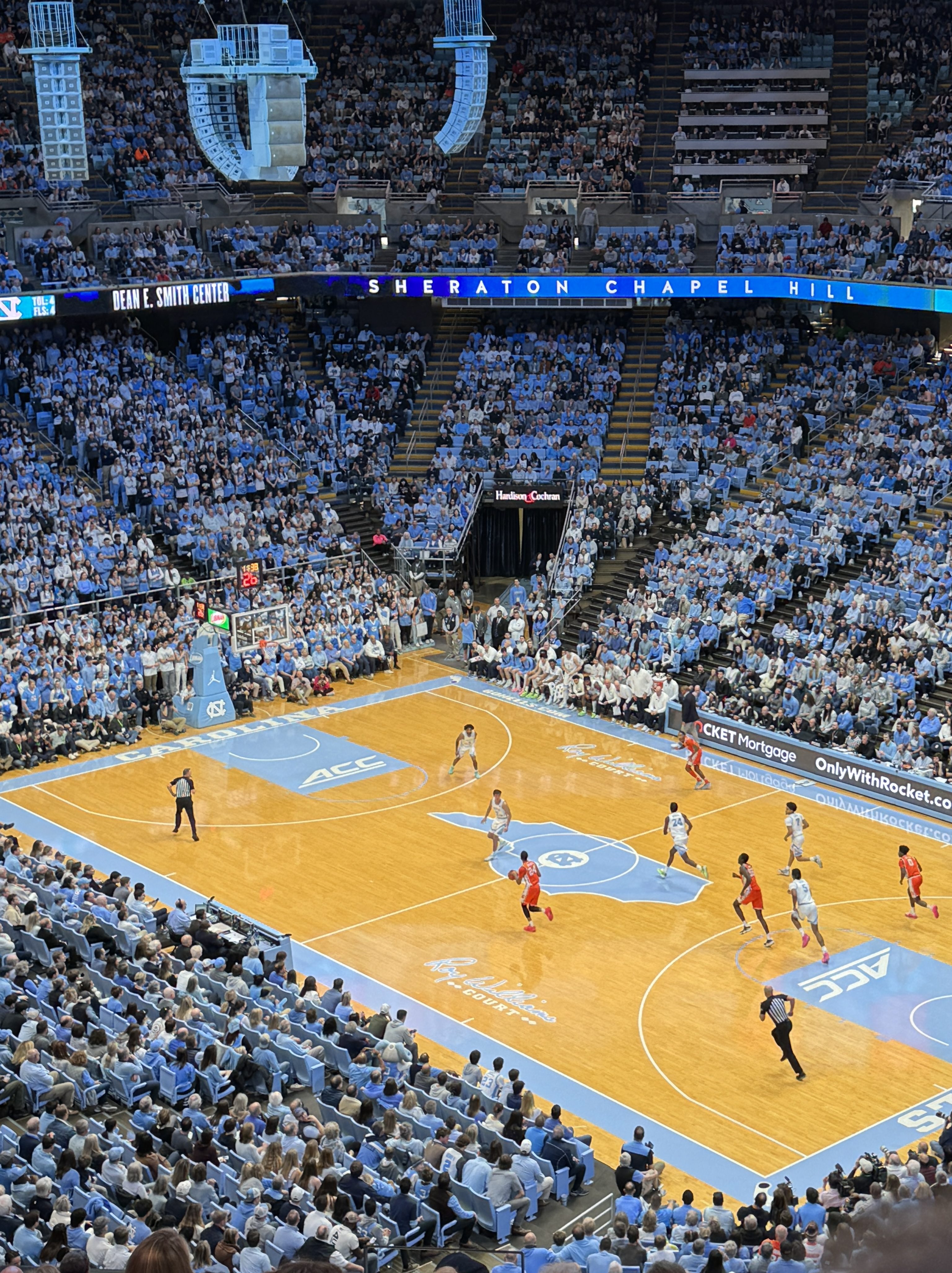
Dean E. Smith Center, UNC, 2023. Photo by Caroline Conner
Many, including former Alabama head coach Nick Saban, believe this new era of NIL is putting schools at a competitive disadvantage and they are highlighting the need for rules that establish a level playing field. Saban told “NIL Daily” on Sports Illustrated that, “It [NIL] has to be done in a way where you have some kind of competitive balance. Every school must have the same thing. One school can’t spend $30 million for players while another school is spending $3 million.”
In an attempt to provide a solution to this issue, the House v. NCAA case settlement was approved in June. This landmark agreement changed college sports forever. It allows for schools to directly pay athletes for the first time in history. This new revenue sharing model, according to The Athletic, allows athletic departments to “distribute roughly $20.5 million in name, image and likeness (NIL) revenue to athletes over the 2025-26 season.”
Previously athletes could only receive NIL compensation via outside organizations, such as local businesses, large brands like Nike or school donor collectives. The new House settlement also places a limit on team roster sizes, which has forced schools to adjust their scholarship distribution approach.
“We’ve already adjusted our scholarship limits for our sports going into the 25-26 year.” She added that USF is focused on “implementing it [House settlement] in a way that the student athletes are benefiting from it as they were intended to do so,” Pierce said.
Another aspect of the House settlement that is affecting college coaches and NIL donors alike is the establishment of a new NIL rule enforcement committee, known as the “College Sports Commission.” This entity is responsible for reviewing all NIL deals worth over $600 and determining whether they are “for a valid business purpose and reflect fair market value,” according to The Athletic. Many coaches seem optimistic and grateful for the creation of this committee, as it will aim to thwart any attempts to overcompensate athletes for minimal to no contribution to NIL providers.
Washington Huskies athletic director Pat Chun told Sports Illustrated, “We all recognize that nobody wants to exist in an unregulated, unsustainable environment. Relative to enforcement, I’m probably optimistic because, knowing what’s been done in the past, this is backed by a court-approved settlement.”
According to Yahoo Sports, some schools had been “hurriedly signing current players and transfers to new contracts before the approval of the settlement in deals that frontload a majority of the compensation.” The rush was driven by the fact that any contracts signed before the settlement approval and paid out before July 1 were not subject to the clearinghouse (College Sports Commission) or cap.
“Death Valley”, Clemson, 2023. Photo by Caroline Conner
For many fans, the biggest impact of NIL is its tendency to result in players transferring. Logically, if a different school offers a player more NIL money or resources, they are likely to transfer. Kris Pierce, a UNC Chapel Hill alumna, says, “I think I grew up in a golden era of college athletics. Being a Tar Heel, I know the value of folks staying around four years.”
Before the addition of NIL and the era of paying athletes, most players stayed at their respective schools for the duration of their college careers. This began to change in 2021, following the COVID-19 pandemic, when the NCAA granted every active student athlete one penalty-free transfer. With the introduction of NIL in 2021 as well, the floodgates were opened, sending a wave of student athletes into the transfer portal. These waves have continued to grow over the last four years with the increase in financial support of NIL.
That begs the question: will college athletics ever return to its “golden era” that so many miss? Only time will tell. For now, the introduction of the College Sports Commission and NIL spending cap, in an effort to control the transfer portal, is a step in that direction.
Baseball, the one sport that has a player that can decide every play, the pitcher.
The pitcher is the most important player on the field. For example, if he throws a pitch right down the middle, bye bye ball. But if he throws a pitch at the very corner of the strike zone, every player is just going to stare at it until the umpire calls it a ball or strike.
Leighton Finley, a 6’5, 235-pound sophomore walk-on pitcher at the University of Georgia threw 104 pitches in one game. He threw into the high 80’s and low 90’s on every single pitch.
“I compare pitchers that can throw fast to sports cars,” said former UGA baseball coach Scott Stricklin.
Just like cars, when pitchers throw fast constantly without a break, they can break down.
Stricklin said there are ways a pitcher can avoid injuries, mainly focusing on specific workouts. “For a guy like Leighton Finley, when he’s out on the mound — that’s the fun time. No one gets to see the work he puts in before and after that.”
“Pitchers that throw at a high level, have a high-level process,” he said. “When you see them throw on Friday, you’re not seeing what they do on Saturday through Thursday. The real work is when they’re not throwing.”
Stricklin said running, working in the weight room and doing a throwing program is critical for pitchers. He cited Roger Clemens as an example of a pitcher who put in a tremendous amount of work.
“Roger Clemens was notorious for working so hard in between his starts,” he said.
The main problem is the rotator cuff. The part of the arm that moves the arm around in circles. The rotator cuff is the main injury that pitchers get. Pitchers are always moving in that unnatural motion that the arm is not meant to move in and hurt their arms.
“The risk of injury is always going to be there when you’re doing something at a high level,” Stricklin said. “When injuries happen, you have to do everything you can do overcome it.”
The rotator cuff is the main part of the arm for baseball pitchers. There are people as young and even younger than 14 that have to have surgery because they go over their limits. Some experts hold firm to keeping pitchers under a certain pitch count to avoid injury. However, former Georgia third base coach Scott Daeley doesn’t think limiting pitch counts is necessarily the answer.
“As far as pitch counts, everyone is a unique individual,” Daeley said. “I’ve seen a number of pitchers that come through the SEC where coaches have extended them to 130, 135 pitches who haven’t gotten hurt, whereas pitchers on a pitch count of 80 have gotten hurt.”
Regardless of the athlete’s size or the speed of their pitches, training is the most critical factor for avoiding injury. Daeley agreed with Stricklin that maintaining a good workout regime is the key to staying healthy — pitch counts and rest are secondary. “I don’t think anybody really has the formula of what number of pitches or how much rest will or won’t get someone hurt,” he said.
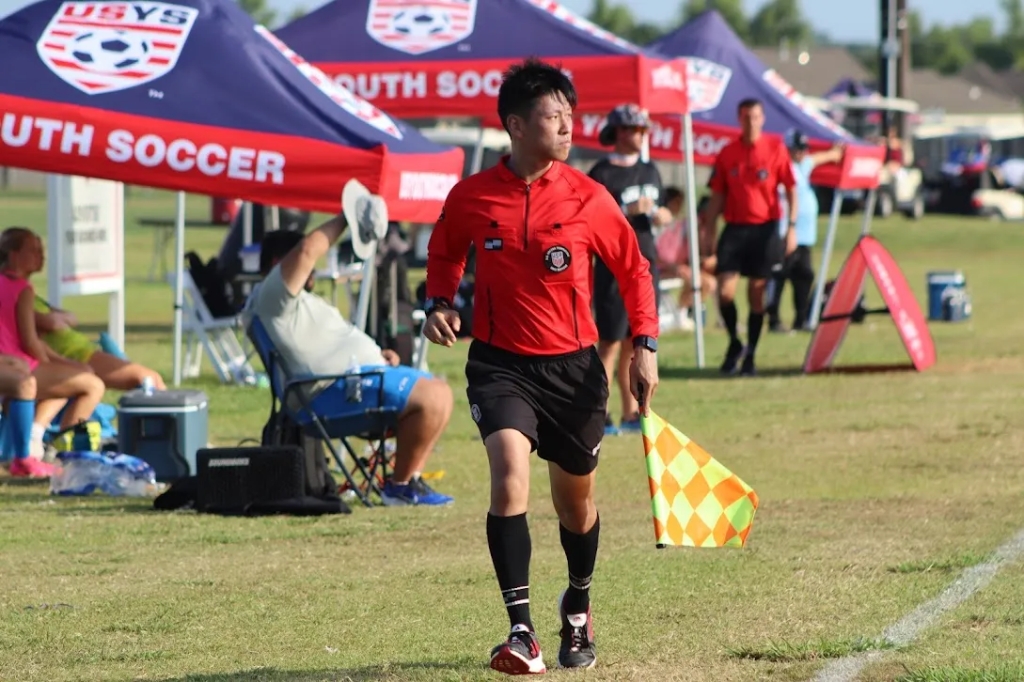
“Ref make the damn call!” Two minutes into the game and the parents were already going. “Referee how is that not a f****** foul?!” Maybe because the kid tripped over his own feet. “This ref is shit!” Not even halftime yet and I’ve heard everything and more. “Ref go to h***!” These are 9 year old kids out here playing recreational soccer, it can’t be that deep to you.
These were the kind of things I heard the first game I worked as an assistant referee. My first game ever. From the minute the first whistle was blown, it seemed like the parents were more worried about me than their own kids out on the field. They yelled and verbally abused me the whole game.
It ranged from screaming, to profanity, to things 8 year old kids just shouldn’t be hearing. Every time I made or didn’t make a call, it seemed like a fire went off behind me. I remember one dad slamming his hat on the ground and stomping and screaming at me and my other referees. Sometimes, they would even come up behind me and yell.
Now that I have much more experience as a referee, I am more composed under circumstances like those. At the time though, the whole thing had me a little shaken. Not too long ago, I was refereeing a final of a tournament all by myself. The parents were worse than the first time, at one point a dad stepped onto the field arguing a call I made. At that point, I stopped the game for a minute and told the whole sideline to let the kids play. I tried to say it as confidently as I could, but under these circumstances, it became hard.
This is just a small example of a bigger problem though. Across the United States, parents abusing referees is turning into a major problem. Just a few years ago in 2021 in California, a man angry about a call in a recreational game of 11 year olds ran across the field and decked a referee that was half of his size. The parent received a red card, but the issue was clear to see. Parents have gotten out of control in youth soccer.
Another problem with this is that they teach their kids that this is ok. That it’s ok to act like that when you don’t get your way, that it’s ok to mistreat officials, that it’s ok to be aggressive with people whenever you want. At the end of the day, parents have to do better.
Sometimes, parents wonder why they don’t have enough referees. This is why. Earlier this year in February, in Pennsylvania, the state referee administrator announced that they were in need of many referees to let games go on as scheduled. CBS News reported that the main reason for the lack of referees stems from people unwilling to deal with unruly spectators. It’s not only Pennsylvania though, as across the country, referees are needed in many places. Many of these referees are teenagers, and when crowds of 50 year old men are yelling at us forever, it becomes a lot to deal with.
Regardless of what’s happening on the field, parents’ behavior is not condoned. Even if referees do make mistakes, parents need to be patient. We don’t have all the technology and perfection required to get every single call spot on at the youth level. With that being said, referees are human and just like other people. Parents need to focus on cheering and supporting their kids and focusing on the game itself. The referees are there to make the game run, but lately parents seem to want to make the game about the refs.
Since I was a kid, my parents have always respected referees, so I have followed suit. Other than the occasional “c’mon ref,” they don’t do too much. A “c’mon ref” is ok. What’s not ok is the screaming profanities, the inappropriate comments, and disrupting the flow of the game. My parents come to the game and cheer on my team. A bad call here and there goes unnoticed because the game is so fast and they make the game about us players. When parents stop worrying about the refs, the game flows and is a lot more enjoyable to watch.
“Ref make the damn call!” Sometimes refs want to react, but they are told that is not their place. Solutions to this are hard to come by right now. For me one time out of all my times refereeing, an assignor came over and told the parent he needed to calm down or leave. That calmed the man down until the assignor was out of earshot, and then he was at it again. Parents are going to be parents, but they need to be better.
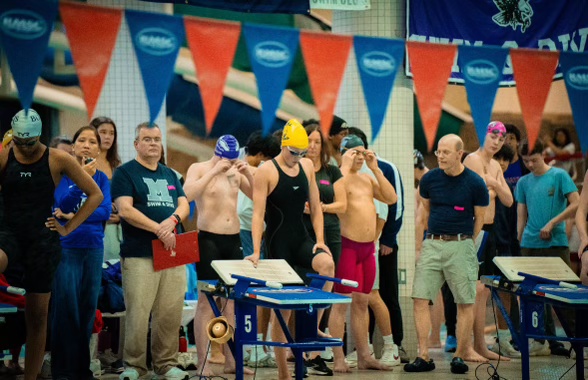
You’re on the starting block, with thousands watching you in person and millions watching you on live TV. One millisecond. That’s what can separate you from the athlete next to you, from giving you a chance to fulfill your dream of competing in the Olympics. The pressure is intense.
Photo by Bradly Steiner
How should you cope with this?
Treat it like any other race.
“The best thing you can do is to not make it a bigger deal than it is,” said Coach Blanken, Bethesda Chevy Chase, ASA and River Falls swim coach. “Because at the end of the day — whether it’s a 50 freestyle or 200 backstroke —, it’s the same [event] that you did, and you know, even if it was two years ago, it’s the same swim from the last time. It’s just a different pool under a different set of lights, but the actual activity is the same. So treat it that way.”
Ranked first in the class of 2026 in Maryland, 16 year-old Virginia Hinds, secured her place in this week’s Olympic trials with a time of 2:13.14 in the 200 backstroke. Hinds swims for the ASA (All Star Aquatics), Bethesda Chevy Chase’s Varsity team, as well as CCRA.
The trials are a big event on the swimming schedule and attract big TV audiences. Despite her young age, Hinds seems to be heeding her coach’s advice and taking the pressure and attention in stride.
“There’s a good amount of pressure sometimes but for me I just try to not think about the pressure and have fun,” Hinds said. “At the end of the day, as long as I’m having fun and happy with my races that’s all that matters to me.”
Hinds is following closely in the footsteps of Olympic gold medalist Katie Ledecky. Both are determined and hard working swimmers who hold many swimming records. Hinds spends the majority of her time in the water, and started swimming because of her older sister, Clara.
“I’ve looked up to my sister mainly because she is the reason I started swimming and is always my biggest supporter,” Hinds said.
Maryland Olympic swimmers Phoebe Bacon and Katie Ledecky swam at the same Stone Ridge Pool where Hinds currently trains. Bacon and Ledecky began their remarkable journeys to Olympic success at the Stone Ridge pool, a hot spot of Maryland talent. The state’s strong swimming community and facilities have provided an essential platform for swimmers to develop their skills and move to competing in the US Olympic trials.
Kristinia Lennox swam for Puerto Rico in the 2008 Olympics. Lennox coached GDS High School, NCAP Gold lll as well as the Somerset Dolphins, coaching many swimmers keeping Maryland swimming strong. She was 23 years old when she swam in the Olympics held in Beijing.
Photo by Bradly Steiner
“[Even though] the people are from different nations, the language is the same,” Lennox said. “We all knew how to get up on blocks, set up and go. That’s universal, but it’s just different and definitely very intimidating.”
A former Spanish swimmer Dario Fuentes agreed the pressure around swimming is very intense. As there is a lot of tension within each swimmer.
“We trained for four years to reach our goal that may be decided in less than a minute race,” Fuentes said.
Although Hinds just missed qualifying for the Olympics in 2024, Blanken is proud of his swimmer. “It’s just an unbelievable accomplishment,” he said of her 5th place finish. “And it’s one that she’ll have with her forever. She is in a very, very small group of people that can say that they got that far, it’s very difficult to make. So it’s really cool to see.”
Youth club team sports have been revered for their rigorous training, specialized coaching and the market for private youth sports have skyrocketed, but are these high-intensity teams worth the pretty penny?
The U.S Youth Sports Market is reported to be worth $19.2 billion, rivaling the NFL at merely $15 billion and it’s projected to reach $77.6 billion by 2026 according to a report from Wintergreen Research. Where did this surge in popularity and worth in youth sports come from? Well, the most likely answer is privatized club sports teams. So what’s the deal with club sports? Why are parents pouring their income into travel teams and private coaching?
Oconee High School rising Freshman Marin Torres has been swimming since she was 5-years-old and went on to swim on OHS’s swim team as an eighth grader. Upon joining a club team in 2019, she finds it to be more intense than her school team.
“It’s more competitive, that’s for sure. And practice (is) every day, so definitely more rigorous than school swim,” Torres said. “And definitely more organized than school swim because school swim, my coach even mentioned that no one else wanted to be the swim coach so that’s the only reason why she’s there.”
Torres also notes how her school team can’t have tailored coaching due to the vast differences in skill level.
“There are only two groups, pretty much split into the ones who can swim already and the ones who need help swimming, and then their practice is not that strenuous,” Torres said. “The coaches don’t really keep an eye on you. They kind of just trust you to swim.”
However, while the coaching is lacking, Torres finds richer experiences with her school team.
“The swim meets are fun because you get to see people from other high schools and you’re with your friends from school,” Torres said. “Also you get swim uniforms and a Letterman jacket, you’re representing your school, but other than that, it’s just kind of like a fun thing to do for me. Not really like a competitive thing.”
Though with club, Torres noticed the divide between athletes due to economic status.
“It’s not a cheap thing. So it kind of feels wrong that club is more expensive, therefore you get better training, but that’s how sports works. So I do notice that the people with money tend to be better because they get the training.”
Despite the costs and benefits of either teams, Torres finds balance in both.
“I feel like if I dropped club and just did high school, it would be more of just a fun (thing) because practices aren’t that hard so you just go and talk to your friends and the coaches don’t really care,” Torres said. “But if I only did club, it’d be a competitive environment. So I think a mix of two is really good because then you get the fun and also the training you need.”
For Jim Peeples’ first 15 years at Piedmont University he coached the baseball team before he stepped away to fulfill his new duties as the Athletic Director for the next seven years. Prior to his professional career however, he was a tri-sport athlete and swam on a club team in his hometown but chose his high school athletic career over the private club experience.
“I transitioned out of swimming because my high school didn’t have a swim team. So for me to continue, I would have missed out on playing the other sports at my high school” Peeples said. “Now, I could have continued swimming at the club but I really wanted the chance to compete for my high school.”
Peeples, similarly to Torres, found more enriching experiences and relationships on his high school team. Making him thankful that he chose high school over his club.
“All these years later, there’s a group of us that get together and we go on a golf trip in the spring,” Peeples said. “So 40 years out of high school, a group of guys that played sports together, we still get together today. So those are lifetime bonds that we built because of our involvement in high school athletics.”
As Athletic Director, when reviewing recruits Peeples has seen fewer ideal athletes as club has become more highly regarded than high school teams.
“There are a lot of talented kids playing travel sports, but there’s a difference between being talented and being a great competitor. I would rather have the young person in my program who’s the great competitor and who competes for the good of their team, then the kid who’s ultra talented and doesn’t compete all that well. And also, that’s really what our coaches are looking for. Who are those great competitors who are going to be those great teammates? Who is going to be the person who puts themselves second and their teammates first? Travel sports has taken away from that a little bit right”
After playing both travel ball and high school sports, Andrew Klein graduated from Piedmont University in 2023 and is slated to be a paraprofessional at a Middle School in Habersham county where he will also coach baseball. As a K-12 student, Klein played travel baseball and continued to play through Piedmont before quitting and transitioning to coach at a private club, but Klein argues that the private youth sports industry has progressed into more of a flashy lifestyle than an industry based in producing athletes.
“It definitely is more of a money grab nowadays,” Klein said. “Parents want to be so fast to spend the money and get the cool jerseys or have the cool walk up music for their kids and just say they play travel sports,” Klein said.
As a coach, Klein attempts to steer his athletes away from the false narrative of promised attention and success just for being in the club and to instead find joy in the game.
“I just try to tell kids that no matter the money, you first got to find the right coach for you, you’ve got to find the right players that you want to play with, how you want to play the game first, and focus a lot less on just your win loss record,” Klein said. “Social media has all these people being able to post their highlights and tag these college coaches and it seems like it’s just a persona that they want to be like other kids that post these things and it’s more about how they look and how people perceive them then what their skills are (and) how much they actually love the game.”









 Rock Star Writers Blog